
Key takeaways
- AP internal controls are the approvals, access limits and reviews that make every payment legitimate, accurate, authorized and traceable.
- Segregation of duties does not require more staff. In a small practice, the client owner becomes the second person who approves bills and releases the payments the bookkeeper prepares.
- The most dangerous combination is one person who can change vendor bank details and release payment. Split that first.
- A vendor bank change needs a callback to a phone number already on file. Business email compromise works because the email thread looks real.
- Duplicate payments are a process failure. One intake channel, invoice number checks and monthly reconciliation catch most of them.
- Plooto lets clients approve before money moves and gives every user their own login and permissions, so bookkeepers never need to hold a client's bank credentials.
A bookkeeper enters bills, maintains vendor records and prepares payments for six clients. A saved bank login for each client sits in the browser. Nothing has gone wrong yet. But if one vendor email is fake or one password leaks, nobody stands between the request and the money leaving the account.
AP internal controls close that gap. For most practices, segregation of duties does not mean hiring. It means three things: the client approves, everyone uses their own login, and there is a record of who did what.
This guide gives bookkeepers a segregation of duties matrix for small teams, practical safeguards against accounts payable fraud and duplicate payments, and a controls checklist to run on every client.
What are AP internal controls?
AP internal controls are the approvals, access limits and reviews that make sure every payment is legitimate, accurate, authorized and traceable. They cover the full accounts payable process, from adding a vendor to reconciling the bank account.
The COSO Internal Control framework groups approvals, verifications, reconciliations and segregation of duties under "control activities." It pairs them with monitoring, which checks that those controls keep working over time.
Accounts payable internal controls come in three types:
- Preventive controls stop a bad payment before it happens. Example: the client must approve before a payment is released.
- Detective controls find problems after the fact. Example: the monthly reconciliation flags a payment with no approved bill behind it.
- Corrective controls fix the gap that let a problem through. Example: limiting who can edit vendor bank details after an incident.
The stakes are real. According to the ACFE's Occupational Fraud 2026: A Report to the Nations, organizations lose an estimated 5% of revenue to fraud each year, and the median case cost $104,000 USD. More than half of the cases involved either a lack of internal controls or an override of existing ones.

Why bookkeepers carry more AP risk than they should
Bookkeepers often hold more access than anyone at the client except the owner. Three patterns drive most of the exposure:
- Shared or saved client bank logins. The bookkeeper can technically release any payment, with no second person involved.
- Approvals by email. They are easy to fake and hard to find six months later.
- Work split across three places. The bank portal, a spreadsheet and the ledger each hold part of the story, and none holds all of it.
When a payment goes wrong, the bookkeeper's reputation and the client relationship take the hit, even if the bookkeeper did nothing wrong. That is the liability bookkeepers carry when controls live in someone's head instead of in writing. A good control fixes this with three parts: an owner, a trigger and evidence that it ran.
Segregation of duties in accounts payable
Segregation of duties in accounts payable means no single person controls a payment from start to finish. Split the AP cycle into five stages and ask two questions at each one: who does this, and who checks it?
1. Vendor setup and bank-detail changes
- Who does it: The bookkeeper adds vendors from a completed vendor form and supporting documents.
- Who checks it: Someone else, usually the client owner, confirms any new or changed bank details by phone.
- Evidence: A change log that shows who edited which field, and when.
2. Invoice entry and validation
- Who does it: The bookkeeper enters bills that arrive through one intake channel, such as a dedicated AP inbox.
- What to check: Every bill has a unique invoice number and supporting documents.
- For clients who issue purchase orders: Use 3-way matching to compare the purchase order, receiving record and invoice before approval. It catches overbilling and bills for goods that never arrived.
3. Approval
- Who does it: The client approves each bill to confirm it reflects a real business purpose.
- The rule: Nobody approves a bill they entered or a payment to themselves
- Dollar limits: Bills above a set amount need a second approver. Good payment approval workflows route bills automatically, so approval never depends on someone remembering to ask.
4. Payment preparation and release
- Who does it: The bookkeeper prepares the payment batch, and the client releases it.
- Above a threshold: Require two approvers before release.
- After approval: Lock the batch. Nobody edits a payee, amount or bank account once it is approved.
5. Reconciliation and review
- Who does it: The bookkeeper matches payments to approved bills and bank activity.
- Who checks it: A reviewer who did not prepare the payments signs off.
- What to look for: Payments with no approved bill, unfamiliar payees and repeated amounts that may mean the same invoice was processed more than once.
Who does what: A segregation of duties matrix for bookkeeping practices
A segregation of duties matrix assigns each AP task to a named role so conflicting duties never sit with the same person unchecked. It works even for a team of two.
How to split duties when the team is small
Can a two-person team segregate AP duties? Yes. The trick is counting the client as part of the control. In a solo practice, the "team" is the bookkeeper plus the client owner who approves bills and releases payments.
The matrix below covers three common practice sizes. The roles are illustrative, so adjust them to each client. Map the roles to how each client actually works, not to job titles.
|
AP duty |
Solo bookkeeper + client owner |
Growing practice (bookkeeper + senior reviewer + client) |
Established firm (junior and senior bookkeepers + client) |
|
Vendor setup |
Bookkeeper |
Bookkeeper |
Junior bookkeeper |
|
Verify vendor bank changes |
Client owner, by callback |
Senior reviewer, client confirms |
Senior bookkeeper, client confirms |
|
Bill entry and coding |
Bookkeeper |
Bookkeeper |
Junior bookkeeper |
|
Bill approval |
Client owner |
Client owner or manager |
Client manager |
|
Payment preparation |
Bookkeeper |
Bookkeeper |
Junior bookkeeper |
|
Payment release |
Client owner |
Client owner |
Client owner; second approver above threshold |
|
Reconciliation |
Bookkeeper |
Bookkeeper |
Junior bookkeeper |
|
Reconciliation review |
Client owner |
Senior reviewer |
Senior bookkeeper |
Compensating controls when duties overlap
Compensating controls are extra checks that lower risk when one person has to hold two conflicting jobs. Match them to the practice size:
- Solo bookkeeper: The client releases every payment and reviews vendor changes and monthly reconciliation exceptions.
- Growing practice: A senior reviewer checks unusual batches and vendor changes before release.
- Established firm: Use role-based access, name backup approvers for holidays and sick days, and review who has access to what every quarter.
Owner-initiated payments and reimbursements deserve a second look at every size. The ACFE found that median losses caused by owners and executives were more than nine times greater than those caused by employees. Where the owner is the risk, recommend an outside review instead of asking the owner to approve their own requests.
Duties never to combine without a safeguard
Some pairs of duties let one person both commit a fraud and hide it. Never let one person, unchecked:
- Change vendor bank details and release payment.
- Enter and approve the same bill.
- Release a payment and sign off the reconciliation that covers it.
- Hold admin access while their own transactions go unreviewed.
Put the split in writing
The engagement letter should spell out who does what and reference any written internal control procedures. Include:
- What the bookkeeper prepares and what the client authorizes.
- Who verifies vendor bank changes.
- Who escalates suspected fraud, and to whom.
State plainly that bookkeeping is not an audit or assurance engagement. Clear scope protects both sides if something goes wrong.
Common accounts payable fraud schemes and how to stop them
Most accounts payable fraud exploits a gap in approval, verification or review, not clever technology. The ACFE ranks billing schemes and cheque and payment tampering among the most significant fraud risks. Here are the schemes bookkeepers see most, and the controls that stop them. Several overlap with the most common payment fraud risks small businesses face.
Fake vendors and padded invoices
A fake vendor is a shell business set up to collect payment for goods or services that never arrive. Padded invoices inflate the quantity or price on a real vendor's bill. A related trick splits one large invoice into several small ones to stay under an approval limit.
Watch for these warning signs:
- A new vendor with no website, contract or GST/HST registration number.
- Bills with no supporting documents.
- Round amounts, or amounts sitting just under an approval threshold.
Verify every vendor before activating it, and review the vendor list each quarter for duplicates and dormant records. Strong vendor payments management makes these checks routine instead of occasional.
Vendor bank-detail changes and business email compromise
Business email compromise (BEC) happens when a criminal spoofs or takes over a real email account and asks for payment to a new bank account. The RCMP notes that spear phishing, which includes BEC, remains one of the top reported scams among roughly 40 fraud types the Canadian Anti-Fraud Centre (CAFC) tracks. The CAFC reported that Canadian businesses lost more than $58 million to spear phishing in 2023.
In the AFP's 2025 survey of US organizations, 79% faced attempted or actual payment fraud in 2024.
A real-looking email thread is not verification. A common version, flagged by the federal Get Cyber Safe campaign, is a duplicate invoice from an existing supplier with "updated" payment details. Protect clients with three habits:
- Call back on a known number. Use a phone number already on file, never one in the request.
- Hold the first payment. Payments to new banking details wait until someone other than the requester confirms them.
- Lock down logins. Turn on multi-factor authentication (MFA) for email and payment accounts, as the Canadian Centre for Cyber Security recommends.
Cheque fraud and payment tampering
Cheque fraud includes altered payees or amounts, stolen or washed cheques and forged signatures. Payment tampering is the electronic version: someone edits a payment file after it was approved.
- Restrict signing authority to named people.
- Lock payment batches once they are approved.
- Ask whether the client's bank offers positive pay, a service that compares cheques presented for payment against the list of cheques the business actually issued.
Moving vendors from cheques to electronic funds transfer (EFT) removes most of this exposure. ShelvingMate stopped cheque fraud after someone added an extra zero to a supplier cheque twice in one month. The company moved supplier payments online and kept final approval with its founder.
What to do when you suspect fraud
Speed limits the damage. In the ACFE study, frauds caught within six months had a median loss of $40,000 USD, while schemes that ran more than five years topped $1.1 million USD. If a payment looks wrong:
- Hold or stop the payment if it has not cleared.
- Call the client's bank right away. Early reporting gives the bank the best chance to freeze funds.
- Keep the emails, bills, approval records and system logs exactly as they are.
- Tell the client owner.
- Report it to the CAFC (online or at 1-888-495-8501) and to local police.
Investigation and recovery belong to the bank, police and forensic specialists. The bookkeeper's job is to stop the payment, protect the record and escalate.
How to prevent duplicate payments
You prevent duplicate payments by sending every bill through one intake channel, checking each bill against vendor, invoice number, amount and date before approval, and reconciling vendor statements and bank activity every month. Most duplicates come from process gaps, not fraud.
What causes duplicate payments?
Most duplicates start in one of these gaps:
- The same bill arrives by email and by mail and gets entered twice.
- Invoice numbers are keyed differently, such as "INV-1042" and "1042."
- One vendor exists twice in the system under slightly different names.
- A failed payment is reissued, and then the original clears.
- A credit memo is never applied, so the full amount goes out again.
- A sync error between the payment tool and the accounting software creates a second open bill.
Stop them before approval
- One intake channel per client. Every bill goes to one address or upload point.
- Automatic duplicate checks. Flag duplicate invoices by matching vendor, invoice number, amount and date. Strip prefixes and spaces from invoice numbers before comparing.
- Status check before reissuing. Confirm a failed payment actually failed before sending it again.
- Human review of flags. A flagged bill gets a second look, not an automatic rejection. Some vendors bill the same amount every month.
Catch them after payment
- Reconcile monthly. A regular accounts payable reconciliation against vendor statements and bank activity surfaces payments with no matching open bill.
- Review reissues and credits. Check every reissued payment and every open credit once a month.
- Recover in writing. Send the vendor a note requesting a refund or credit, and record the outcome.
Every duplicate also eats time: finding it, chasing it and fixing the books. That labour adds to the cost of manual payments most practices already underestimate.
How payment automation enforces controls without adding headcount
Payment automation enforces AP internal controls by building them into the workflow, so they run every time instead of whenever someone remembers. For bookkeepers, three features do most of the work:
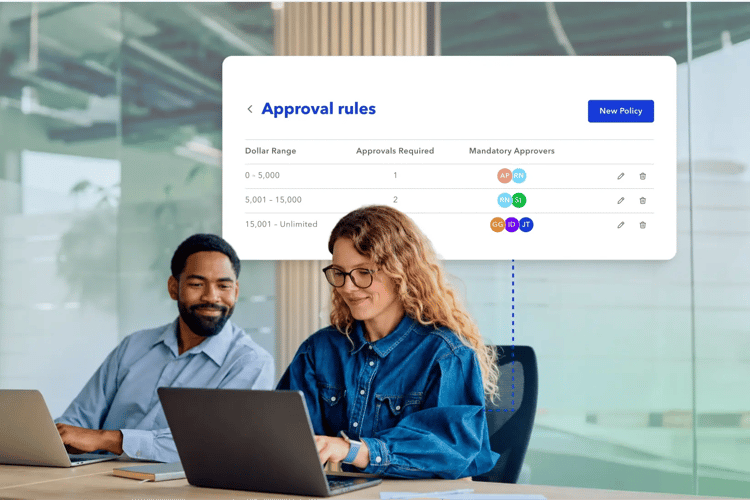
- Approval rules that block release. A payment cannot go out until the client approves it, and larger amounts trigger a second approver.
- Individual roles instead of shared logins. Each person gets their own login, with permissions that match their job.
- A complete record. The system logs who created, approved and paid each bill. A clear audit trail turns "I think the client approved it" into evidence.
AP automation software can enhance internal controls in the AP system. It does not replace the callback that verifies a bank change or the human review of a reconciliation. Treat automation as the enforcement layer, not the whole control system.
For a client-by-client approach to setting up approval rules, follow the AP automation implementation guide.
How Plooto helps bookkeepers keep controls in place
With Plooto, clients approve before money moves, so bookkeepers never need to hold a client's bank login again. Set custom approval rules and user permissions for each client, track every payment from creation to release, and sync bills and payments both ways with QuickBooks Online and Xero.
Plooto has completed a SOC 2 Type 2 audit and offers two-factor authentication; see Plooto security for details. It is accounts payable and receivable software built for practices that manage payments for many clients.
An AP controls checklist for every client
An AP controls checklist confirms each control actually ran, not just that it exists on paper.
Run it on one payment cycle per client
Pick one recent payment cycle for each client. Include a new vendor and a bank-detail change if either happened in that period. For each control, look for proof: a log, an approval record or a signed reconciliation. "We always do that" is not proof.
Keep that proof. The Canada Revenue Agency generally requires business records to be kept for six years from the end of the last tax year they relate to, and approval and payment records support those books.
|
Control |
Evidence to check |
Result |
|
New vendors verified and approved |
Vendor approval record |
Pass / Partial / Gap |
|
Bank-detail changes confirmed by callback |
Verification log |
Pass / Partial / Gap |
|
Individual logins, no shared credentials |
User list and roles |
Pass / Partial / Gap |
|
Duties split or independently reviewed |
Matrix for this client |
Pass / Partial / Gap |
|
Bills supported and matched |
Bill and supporting documents |
Pass / Partial / Gap |
|
Duplicates screened |
Exception report |
Pass / Partial / Gap |
|
Client approval before release |
Approval history |
Pass / Partial / Gap |
|
Release limited to named people |
Payment release log |
Pass / Partial / Gap |
|
Bank and AP reconciled and reviewed |
Signed reconciliation |
Pass / Partial / Gap |
|
Exceptions and changes reviewed monthly |
Review log |
Pass / Partial / Gap |
Fix the biggest gaps first
Rank each gap by how much money could leave without anyone noticing.
- Critical: One person can change bank details and release payment. Bank changes go unverified. Client bank logins are shared.
- High: Approvals are missing. Months sit unreconciled. Nothing screens for duplicates.
Record the owner, target date and evidence for each fix, so next year's review can confirm it held.
Make it part of every client onboarding
Run the checklist when a client signs on and repeat it each year. Between reviews, track control exceptions per client: unverified bank changes, approval overrides and unresolved reconciliation items. A rising count is an early warning that a control is slipping. The implementation guide linked above covers rollout across a full client list and the KPIs worth tracking.
Stronger AP controls start with clear ownership
Strong AP internal controls come down to clear ownership. The client approves. Bank changes are verified by phone. Duplicates are caught before and after payment. Someone other than the preparer reviews the reconciliation.
None of this needs a bigger team. It needs a written split of duties and tools that enforce it.


