

Key takeaways
- Cash flow management is a timing problem, not just a profit problem. A business can be profitable on paper and still miss payroll if money goes out before it comes in.
- The buffer is thinner than most owners think. The JPMorgan Chase Institute found the median small business holds only 27 days of cash, and a quarter hold 13 days or fewer.
- Uneven cash flow is the norm, not the exception. In the Federal Reserve's 2024 Small Business Credit Survey, 51% of small employer firms named uneven cash flows as a financial challenge.
- Five habits do most of the work: a simple forecast, faster receivables, deliberate payables timing, a defined cash buffer, and a standing weekly review.
- Cash flow visibility is the piece most businesses are missing. Knowing what is scheduled to leave, what is due to arrive, and where you stand today is what turns cash flow management from guesswork into a routine.
- Plooto brings accounts payable, accounts receivable, and two-way accounting sync into one place, so the cash position you see reflects what is actually happening in your bank and your books.

The JPMorgan Chase Institute analyzed 470 million transactions across 597,000 small businesses and found the median firm holds enough cash to cover just 27 days of normal outflows. A quarter of them hold 13 days or fewer.
That is the real stakes behind cash flow management. It is not an accounting exercise. It is the difference between covering payroll in a slow month and calling your bank in a panic.
This guide covers what cash flow management actually means, why the problems show up where they do, and a practical framework you can run every week. It is written for small business owners and for the bookkeepers and accountants who manage cash on their behalf. By the end, you will know how to forecast simply, collect faster, time your payments on purpose, and see your cash position without stitching together three spreadsheets.
What cash flow management actually means
Cash flow management is the practice of tracking, predicting, and controlling the money moving in and out of your business so you always have enough on hand to meet your obligations. It answers one question on repeat: will there be enough in the account after expenses are paid?
Cash flow is about timing, not just totals
Profit and cash are two different measurements. Profit tells you whether your business model works over a period. Cash tells you whether you can pay your bills on Thursday.
A landscaping company can invoice $80,000 in June, book every dollar as revenue, and still be short in July if those invoices are on 60-day terms while payroll runs every two weeks. Nothing is wrong with the business; the timing is unfavorable.
Managing cash flow means managing that gap. You are lining up the calendar of money arriving against the calendar of money leaving, then closing the distance between them.
What this guide covers
Accountants split cash flow into three categories, and it helps to know which one you are working on.
- Operating cash flow: Money generated and spent through day-to-day business activity, including customer payments, supplier bills, payroll, rent, and taxes.
- Investing cash flow: Money tied to buying or selling long-term assets such as equipment, vehicles, or property.
- Financing cash flow: Money moving between the business and its lenders or owners, including loans, repayments, and owner draws.
This guide is about operating cash flow. That is the layer owners and bookkeepers touch every week, and the layer where small decisions compound fastest. If you want the accounting theory behind how these categories roll up, start with cash flow statements and how they are built.
Why cash flow management matters more for small businesses
Cash flow management matters more for small businesses because the margin for error is smaller. A large company with a credit facility can absorb a customer paying 45 days late. A 12-person firm often cannot.
Thinner buffers leave less room for error
The buffer data makes the point plainly. The JPMorgan Chase Institute found the median small restaurant holds 16 cash buffer days, while the median small real estate business holds 47. Same country, same economy, wildly different tolerance for a single late payment.
That thin cushion changes what a delay costs. When a $30,000 invoice slips two weeks at a business with 20 days of buffer, it is not an inconvenience. It is a decision about which supplier waits.
The Federal Reserve's 2024 Small Business Credit Survey shows how common the squeeze is. Among small employer firms, 51% cited uneven cash flows as a financial challenge and 56% cited paying operating expenses. In the following year's survey, 60% of firms applied for financing, and the most common reason was simply to meet operating expenses.
Borrowing to cover a timing gap is expensive. Managing the timing is cheaper.
What Canadian small businesses face right now
Canadian businesses are managing cash against real cost pressure. Statistics Canada's Canadian Survey on Business Conditions found that 64.3% of businesses expected cost-related obstacles in the second quarter of 2026, up from 58.9% the previous quarter, with nearly half pointing specifically to inflation.
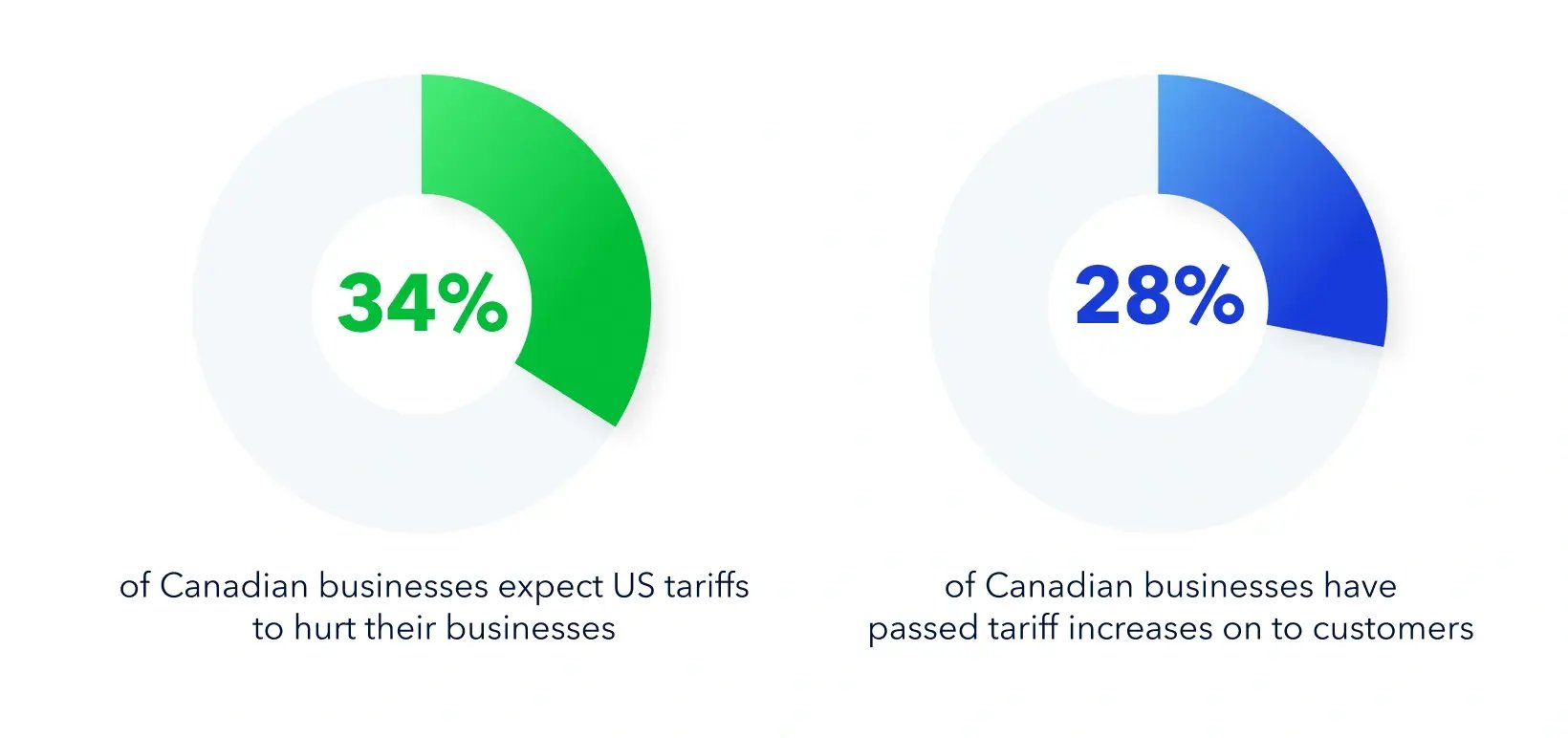
Trade adds another variable. In the same survey, 34.0% of all Canadian businesses expected tariffs imposed by the United States to hurt their business over the following 12 months, and 28.3% had already passed tariff-driven cost increases on to customers.
For businesses buying in USD and selling in CAD, or paying cross-border suppliers, exchange timing becomes part of cash planning. Seasonal industries feel it most sharply, since a slow quarter and a supplier price increase can land in the same month.
None of this is a reason to panic. It is a reason to know your numbers before the month starts rather than after.
Common cash flow problems and what causes them
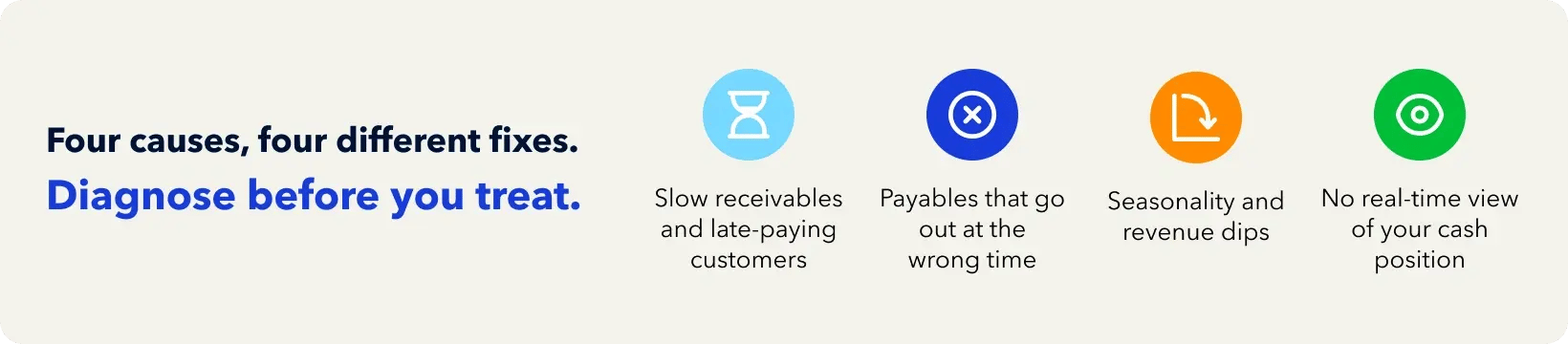
Most cash flow problems trace back to four causes. Diagnosing which one you have matters, because the fixes are different and applying the wrong one wastes effort.
 Slow receivables and late-paying customers
Late payment is the most common cash flow problem for small businesses, and it is usually a process issue rather than a customer issue. Invoices go out days after the work is done, terms are vague, and nobody follows up until the money is already overdue.
Days sales outstanding (DSO) is the metric here. It measures the average number of days between issuing an invoice and collecting on it. Every day you shave off DSO is a day of cash you get back.
 Payables that go out at the wrong time
Paying suppliers is necessary. Paying all of them on the same Friday, by cheque, without checking what is due to come in that week is not.
Cheques make this worse in Canada than most people assume. Payments Canada reports that cheques accounted for just 2% of payment volume in 2024 but 22% of total payment value, which means the slowest instrument in the system still carries a large share of business money. You cannot time a payment precisely when you do not know what day it will clear.
 Seasonality and revenue dips
Seasonal businesses do not have a cash flow problem in the aggregate. They have a distribution problem. The annual numbers work, but the money arrives in four months and leaves across twelve.
The failure mode is treating a strong season as permanent. Fixed costs stay fixed through the quiet months, and the buffer built in summer disappears by February.
 No real-time view of your cash position
The biggest problem is not knowing where you stand. When bills live in one system, invoices in another, and the actual balance in online banking, building a current picture takes an hour of exports and manual matching.
So most people do not do it weekly. They do it when something feels wrong, which is usually too late to act.
|
Cash flow problem |
What it looks like |
Root cause |
Where the fix lives |
|---|---|---|---|
|
Slow receivables |
Invoices aging past 60 days, rising DSO |
Late invoicing, unclear terms, no follow-up |
Automated invoicing and payment reminders |
|
Poorly timed payables |
Cash dips right after a payment run |
Batch paying without checking inflows |
Scheduled payments and approval workflows |
|
Seasonality |
Strong quarters funding weak ones badly |
No forecast across the full year |
A rolling 13-week forecast plus a defined buffer |
|
No cash visibility |
Manual exports to answer basic questions |
Data split across bank, books, and inboxes |
Two-way accounting sync and one connected view |
How to manage cash flow
Managing cash flow well comes down to five repeatable habits. None of them requires a finance degree, and all of them work at a scale of one bookkeeper and a laptop.
- Build a simple forecast
- Get paid faster
- Time your payables deliberately
- Keep a cash buffer
- Review on a regular cadence
Step 1: Build a simple cash flow forecast
Start with a 13-week rolling forecast. Thirteen weeks covers a full quarter, which is long enough to see a seasonal dip coming and short enough that your estimates stay honest.
Keep it to four rows: opening balance, expected money in, expected money out, and closing balance. Pull expected inflows from your open invoices and their due dates. Pull outflows from scheduled bills, payroll, rent, loan payments, and remittances.
Update it once a week and compare last week's forecast to what actually happened. That comparison is where the value is. Within a month or two you will know exactly which customers pay on time and which categories you consistently underestimate.
Resist the urge to build something elaborate. A forecast you update every Monday beats a detailed model you abandon in March.
Step 2: Get paid faster
Getting paid faster is the highest-leverage change most small businesses can make, because it costs nothing and compounds every month.
- Invoice the day the work is done, not at month end. A five-day delay in issuing is a five-day delay in collecting.
- State terms in plain language. "Net 30, due August 26" leaves less room for interpretation than "payable upon receipt."
- Automate reminders before the due date, on the due date, and after. Most late payments are not refusals, they are oversights.
- Offer electronic payment options, including EFT (electronic funds transfer), so customers are not waiting on the mail.
- Ask for deposits on large jobs. A 30% deposit funds the work instead of financing it yourself.
- Escalate on a schedule, not on a mood. Decide in advance what happens at 15, 30, and 45 days past due.
Automating accounts receivable removes the part people avoid, which is chasing. When reminders send themselves and payments reconcile automatically, collections stop depending on whether anyone remembered.
Step 3: Time your payables deliberately
Paying deliberately does not mean paying late. It means choosing payment dates with your forecast open instead of clearing the pile whenever it gets tall.
Batch bills into set payment runs, twice a month is common, and schedule each run against expected inflows. Use approval workflows so the person entering a bill is not the person releasing the money, which protects both your cash and your controls.
Then look for early payment discounts worth taking. A 2/10 net 30 term, meaning a 2% discount for paying within 10 days, is a strong return if you have the cash and a poor trade if taking it drains your buffer.
Understanding how accounts payable affects cash flow makes these calls easier, because you can see what stretching or accelerating a payment actually does to your position.
Step 4: Keep a cash buffer
A cash buffer is money held specifically to absorb timing gaps, not a savings account for future projects. It exists so that one late customer does not become one late payroll.
Given that the median small business sits at 27 buffer days, a reasonable target is 30 to 60 days of typical operating outflows. Seasonal businesses and those with customer concentration should aim toward the higher end.
Build it the same way you build anything else, in increments. Move a fixed percentage of every deposit into a separate account and leave it alone. If you want to work through the math for your specific situation, our guide on how much cash flow a business should keep on hand goes deeper.
Step 5: Review cash on a regular cadence
The weekly cash check-in is the habit that holds the other four together. Fifteen minutes, same time every week, same four questions.
- What is our cash position today?
- What is scheduled to go out in the next 14 days?
- What is due to come in, and which of those are at risk?
- What needs a decision this week?
For accounting firms and bookkeepers managing several clients, this becomes a standing agenda item rather than an ad hoc request. Clients notice the difference between a bookkeeper who reports last month's numbers and one who flags next month's shortfall.
Cash flow visibility to see your cash position in real time
Cash flow visibility is the ability to see your current cash position and your expected position over the coming weeks without manually assembling it. It is the difference between knowing your balance and knowing what your balance is going to be.
What does real-time cash flow visibility actually mean?
Real-time visibility means three things are always current and always in one view.
- What is scheduled to go out: approved bills, payment runs, payroll, and recurring obligations with their dates.
- What is due to come in: open invoices with due dates, flagged by which are current and which are aging.
- Where you stand right now: an actual bank position that reflects payments in flight, not just what has already cleared.
Without those three, you are working from a balance that is already out of date. Money has left that has not shown up yet, and money has arrived that has not been applied to an invoice.
How automation creates a real-time cash view
Automation creates visibility by removing the manual steps between an event and the record of it. When a customer pays, the payment applies to the invoice automatically. When a bill is approved, it appears in the outflow schedule with its scheduled date.
Manual processes break visibility at every handoff. Someone has to export the aging report, someone has to remember which cheques are outstanding, and someone has to key it into a spreadsheet. Each step adds delay, and delay is exactly what visibility is meant to eliminate.
The payment method matters too. Payments Canada found that cheque volume fell 42% between 2019 and 2024 while electronic funds transfers grew 48% in value, and 49% of Canadians now say real-time payments appeal to them. Electronic payments move faster and, more importantly for cash planning, they move predictably.
Why reconciliation is part of visibility
Reconciliation is the step that makes a cash view trustworthy. If your books say one number and your bank says another, the position on your dashboard is a guess.
Two-way sync with accounting software solves this by keeping both systems current in both directions. A payment made in your payments platform appears in QuickBooks or Xero, and a bill entered in your accounting software flows into your payment queue. Nobody re-enters anything, so nobody introduces a discrepancy.
Choosing tools to manage cash flow
The right tool for cash flow management connects your payments to your books and gives you one place to see both sides of the ledger. Three capabilities matter more than the rest.
- Two-way accounting sync with QuickBooks or Xero, so reconciliation happens automatically instead of at month end.
- Automated approvals for payables, so control does not depend on one person's inbox.
- A real-time cash view covering scheduled outflows and expected inflows together.
Everything else is a preference. If you are ready to evaluate specific platforms, our guides to the best AP software and to AR automation software compare options in detail.
How Plooto helps you stay on top of cash flow
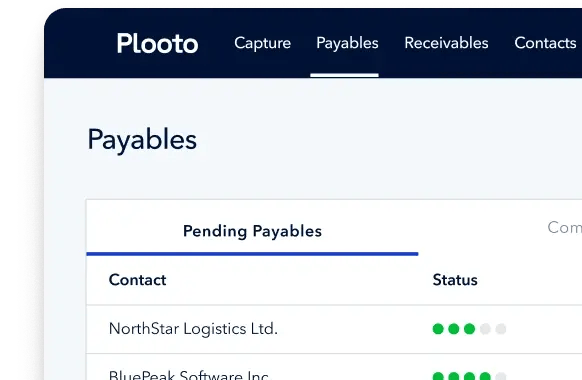
Plooto handles accounts payable and accounts receivable in one platform and syncs both directions with QuickBooks and Xero, so the cash position you see matches what is actually in your books and your bank.
That means approval workflows on outgoing payments, automated invoicing and reminders on incoming ones, domestic and cross-border payments in CAD and USD, and reconciliation that happens without anyone exporting a file.
The time savings are the part customers talk about. Greenhouse saved approximately 40 hours a month and $50,000 a year after moving their payments to Plooto.
More than 14,000 businesses use Plooto to automate their end-to-end payment process. If cash flow visibility is the gap you are trying to close, that is the problem it was built for.
See your cash flow in one place
Making cash flow management a weekly habit
Cash flow management is not a project you finish. It is a routine you keep, and the businesses that stay ahead of it are rarely the ones with the most sophisticated models. They are the ones who look at the same four numbers every week and act early when something moves.
Start with the smallest version. Build a 13-week forecast this week, even a rough one. Turn on automated invoice reminders. Pick a day for your payment run and a fifteen-minute slot for your cash check-in.
The compounding effect shows up faster than most people expect. Cut DSO by a week, move your payables to a deliberate schedule, and you have freed up cash that was already yours. That is money you did not have to borrow, at a moment when 60% of small firms are applying for financing largely to cover operating expenses.
Cost pressure and uneven revenue are not going away. Visibility is the part you control, and it is the part that turns cash flow from a monthly worry into a weekly habit.


