
Manage DSO with a 5-stage dunning process, email templates, and automation tips that preserve customer relationships and speed up payments.
Key takeaways
- A dunning letter is a structured, escalating communication from a business to a customer about an overdue invoice. It is a business communication, not a legal filing.
- According to the 2025 Atradius Payment Practices Barometer, 43% of credit-based B2B sales in the US and 44% in Canada are currently overdue, making a consistent collections cadence a working-capital essential.
- A clear 5-stage dunning process (reminder, nudge, firm notice, final demand, pre-collections) shortens DSO without undermining customer goodwill.
- Automation amplifies whatever policy you configure. Plooto helps SMBs and accounting firms standardize reminders, follow-ups, and audit trails in a single AR workflow.
- Accounting firms benefit most from templated, segmented dunning sequences that scale across portfolios without a dedicated collections analyst per client.
A dunning letter is not a one-off email; it's a system
Most businesses lose money the same way. They send the invoice, they wait, and no oney follows up. The customer is not refusing to pay. The customer just has fifty other invoices in their inbox, and yours is not on top of the stack.
A dunning letter can ehlp. It is a structured communication that walks an unpaid invoice through stages of escalation, from a friendly reminder to a final demand. Done well, it protects cash flow, lowers DSO, and keeps customer relationships intact. Done poorly, receivables age and good customers drift into bad-payer behavior.
This guide is written for SMB controllers, AR managers, bookkeepers, and accounting firms managing receivables across multiple clients.
Dunning letters as a structured escalation system for healthier cash flow
A dunning letter is a written notice (usually email) sent to a customer to request payment on an overdue invoice. The word comes from the 17th-century English verb "to dun," meaning to demand repayment of a debt. Per Investopedia, modern dunning is the methodical communication businesses use to ensure collection of receivables, with messaging that escalates as accounts age.
Why “one overdue email" fails and a dunning process works
Inconsistent follow-up can train customers to pay late. If you follow up on one of your invoices but didn’t communicate about three others did not, they reasonably conclude that yours is not the one to pay first.
A dunning process replaces ad-hoc emails with a system. Each stage has a defined trigger, message, and next action. The shift from "we get to it when we get to it" to "every invoice follows the same predictable path" is what reduces days sales outstanding (DSO) faster than any tone change ever will.
The process is firm. The tone stays respectful.
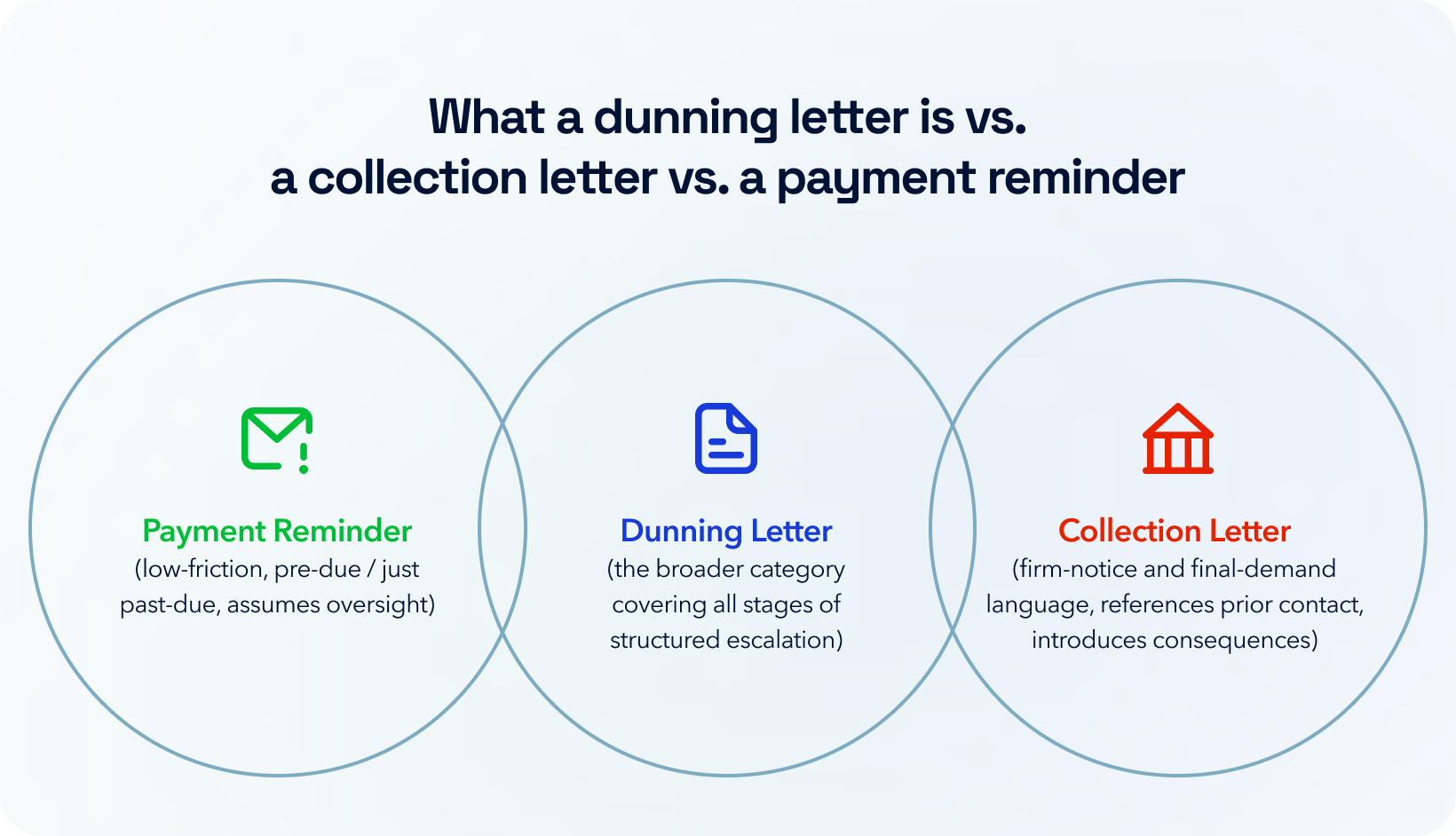
These three terms get used interchangeably, but they describe different stages. A payment reminder is a low-friction notice, usually pre-due or just past-due, that assumes oversight. A dunning letter is the broader category covering all stages of structured communication, from polite reminder through final demand. A collection letter is the language used at firm-notice and final-demand stages, referencing prior communication and introducing consequences. Aligning your team on which term applies at which stage prevents mixed signals to customers.
Where dunning fits in order-to-cash
Dunning sits at the receivables end of order-to-cash, but the work that determines whether it succeeds happens upstream. Invoice accuracy, delivery confirmation, payment options, and a clear dispute path all shape how often you will need to escalate. The accounts receivable process end to end is the foundation. The International Federation of Accountants (IFAC) frames this as systematic credit control: expectations set at engagement and reinforced through consistent process.
When to send a dunning letter and what to confirm first
Timing matters less than what you confirm before the timer starts. If the invoice never arrived or is wrong, no amount of polite escalation will get it paid faster.
The pre-dunning checklist
Before the first reminder goes out, confirm:
- The invoice was actually sent and received, not just "we mailed it."
- The PO number, line items, and totals are correct.
- The reminder is going to the right contact: AP inbox, buyer, or controller.
- There is no active dispute, credit memo, or short-pay in flight.
- Payment options are frictionless: ACH, EFT, card, payment link, remittance details all included.
Skipping this checklist is how AR teams end up sending firm notices to customers who say, with full justification, "We never got the invoice."
Timing triggers that protect relationships
The communication cadence should be based on days past due plus customer segment. A reasonable default starts with a pre-due reminder 3 to 5 days before the due date and escalates through five stages from 1 to 60+ days past due (full schedule below).
Overdue invoices are baseline in B2B credit relationships. According to the 2025 Atradius Payment Practices Barometer, 43% of credit-based B2B sales in the US and 44% in Canada are currently overdue, with roughly 5% to 6% of long-outstanding invoices written off as bad debt.
Decide your “line in the sand" before stage 4 to 5
The hardest part is deciding in advance what triggers a final demand and what happens after:
- What invoice age and value qualifies as final demand
- What service holds, credit-term changes, or deposit requirements apply at that stage
- Who has authority to approve a final-demand message
- When you escalate to leadership or to an external collections partner
Once written, this policy travels with every customer file. Without it, every late account becomes a fresh debate.
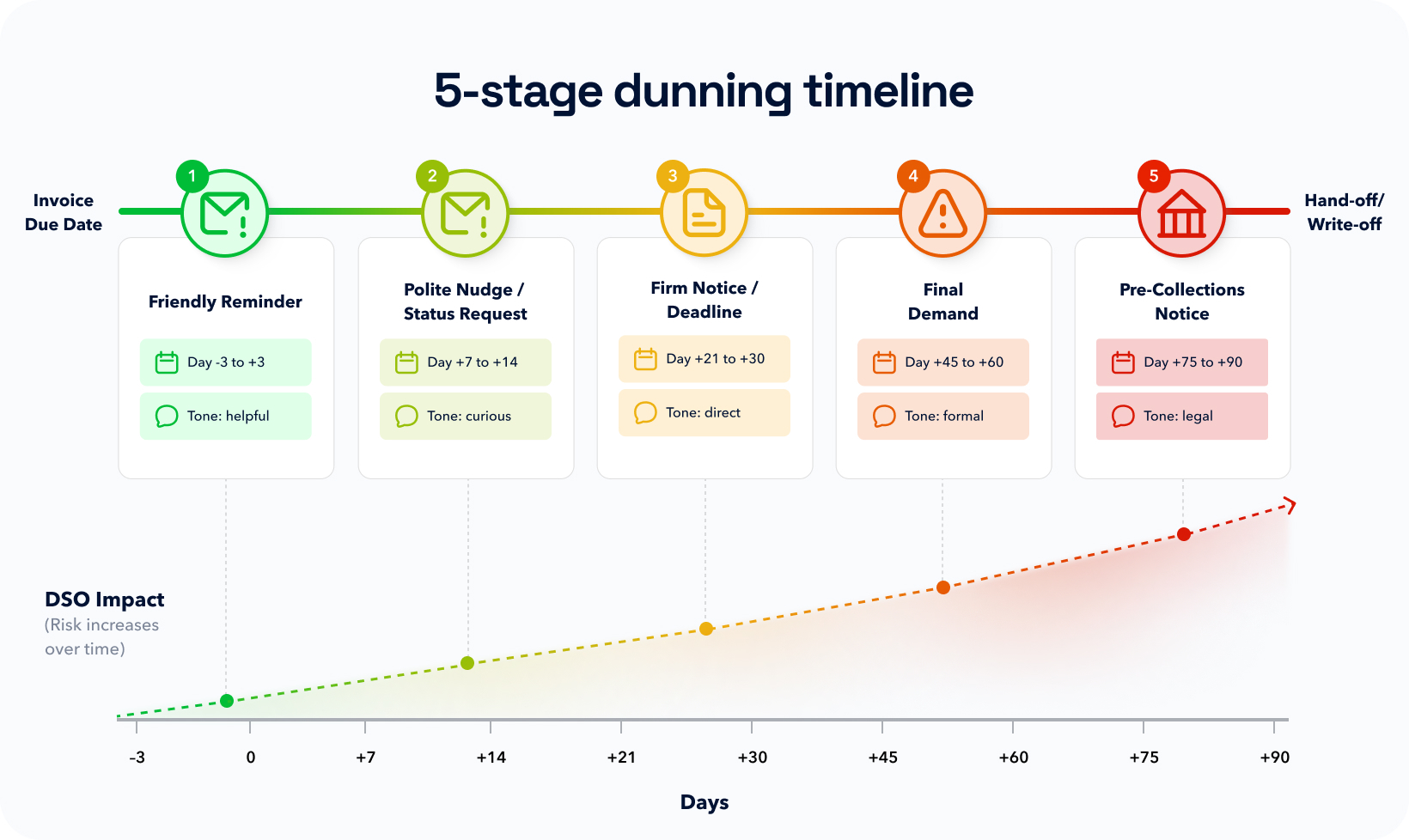
The 5-stage dunning process cadence that reduces DSO without burning goodwill
The default 5-stage cadence gives the customer multiple low-friction chances to resolve before tone or terms shift. Each stage has a job. Get the rhythm right and most invoices are paid by stage 2 or 3.
The stage-by-stage dunning schedule
| Dunning stage | Typical days past due | Primary goal | Tone | Suggested subject line | Must-include elements | Next action if unpaid |
| Stage 1: Reminder | 1 to 3 | Prompt fast payment | Warm, helpful | Reminder: Invoice #___ due on ___ | Invoice link, amount, due date, pay options | Auto-send Stage 2 |
| Stage 2: Polite nudge | 7 to 10 | Get a commitment date | Direct, courteous | Past due: Invoice #___ payment status? | Request ETA, confirm no issues, point of contact | Task for call + Stage 3 |
| Stage 3: Firm notice | 14 to 21 | Set a deadline | Firm, neutral | Action required: Invoice #___ now ___ days overdue | Deadline, consequences, dispute path | Suspend terms, send Stage 4 |
| Stage 4: Final demand | 30+ | Final internal attempt | Strong, professional | Final notice: Invoice #___ must be paid by ___ | Final date, consequences, escalation contact | Stage 5 |
| Stage 5: Pre-collections | 45 to 60+ | Prepare referral or hold | Formal | Notice of intent to refer or apply account action | Referral timeline, documentation request | Refer or place hold |
Segment-based tuning so you don't treat every customer the same
A flat cadence across every account is the second-most-common collections mistake (after no cadence at all). Segment first, then tune:
- High-value strategic accounts: Earlier phone outreach. Account manager loops in before stage 3.
- Customers that spend modestly: Heavier automation. Standard cadence. Manual touch only at stage 4.
- First-time late payers: Slower escalation. Assume good faith.
- Habitual late payers: Tighter cadence. Pre-due reminders standard. Consider deposit or autopay terms.
- Promise-to-pay accounts: Pause sequence on promise. Restart immediately if missed.
Accounting firms can build these segments once at the firm level, then tune by client. This is where templated, multi-tenant AR workflows save hours per week per controller.
Dunning letter templates and tone guidance for each stage
Every dunning email follows the same format:.
- Subject line that names the invoice and signals action.
- One-screen body that says what is due, when, how to pay, and who to contact.
- Payment link that works on first click.
- Attach the invoice PDF.
The variable is tone. Below are templates you can useas a starting frame and match wording to your brand and customer segment.
Stage 1: Friendly reminder dunning email
Subject: Reminder: Invoice #1042 due [date]
Hi [Name],
Quick note that invoice #1042 for $[amount] was due on [date]. If it has already been paid or scheduled, please disregard this note. If not, you can pay using the link below or reply to this email and we will help.
[Pay invoice link]
Thanks, [Sender]
You’re assuming that oversight is the cause, and friction is minimal. Most invoices can be resolved here.
Stage 2: Polite nudge / status request
Subject: Past due: Invoice #1042 payment status?
Hi [Name],
Following up on invoice #1042 for $[amount], which is now [X] days past due. Could you confirm one of the following:
- Payment is scheduled for [date]
- The invoice needs to be re-sent or routed differently
- There is a dispute we should review
[Pay invoice link]
Looking forward to your reply.
[Sender]
This is still collaborative, but asking for a commitment, which gives you something to follow up on at stage 3.
Stage 3: Firm notice / deadline
Subject: Action required: Invoice #1042 is now [X] days overdue
[Name],
Invoice #1042 for $[amount] was due [date] and is now [X] days past due. We sent reminders on [date 1] and [date 2] and have not received a response.
Please remit payment by [deadline] or contact [escalation name] at [email] to discuss payment terms or any dispute. If we do not hear from you by [deadline], the account will be subject to [consequence: e.g., suspension of services, removal of credit terms, late fees].
[Pay invoice link]
[Sender]
This tone shifts to neutral and factual, referencing prior communication with dates. Introduce a concrete deadline and consequence to keep the dispute path open.
Stage 4: Final demand letter language
Subject: Final notice: Invoice #1042 must be paid by [date]
[Name],
This is a final notice on invoice #1042 for $[amount], originally due [date], now [X] days past due. We have sent prior notices on [dates] and have not received payment or a response.
Payment must be received by [final deadline] to avoid [consequence: e.g., account suspension, account hold, referral to a third-party collections partner]. We would prefer to resolve this directly. If there is a dispute or hardship issue, please contact [escalation name] at [email] before [deadline].
[Pay invoice link]
[Sender]
At this point, your communication is short, formal, and references specific dates and consequences. The "we want to resolve this directly" framing keeps the door open without softening the deadline.
Stage 5: Pre-collections notice
Subject: Notice of intent to refer to collections (or place account on hold)
[Name],
Despite multiple notices dated [list], invoice #1042 for $[amount] remains unpaid. Effective [date], the account will be referred to a third-party collections partner, placed on hold, or submitted for credit-term review (whichever applies per your policy).
If you intend to dispute this balance or submit documentation, you must do so by [date]. After that date, the account will proceed as outlined.
[Sender]
Here you remain formal, straightforward, with no inflammatory language. Notice of what will happen, date by which the customer can still respond, documentation cue.
Tone guardrails to avoid relationship damage
A few best practices to follow:
- State neutral facts. Dates, invoice numbers, amounts, prior commitments. Skip the adjectives.
- No shaming language. "We are disappointed" reads as personal. The invoice is the issue, not the person.
- No vague threats. Either name the consequence or do not mention one.
- Separate process from relationship. Account management owns the relationship. Finance runs the collections process.
- Know what regulations apply (if any). B2B commercial collections are not generally covered by the federal Fair Debt Collection Practices Act (FDCPA), which the FTC enforces for consumer debts. The CFPB's Regulation F (including the 7-in-7 call rule) also applies to consumer debt collection. If any portion of your AR is consumer-facing, get legal review before automating. For pure B2B, the underlying principles (no harassment, no deception, accurate information) are still good practice.
“Is your dunning process broken?" diagnostic checklist
If you are not sure whether your collections process is working, the symptoms tend to cluster in three places.
Operational red flags
- No standardized stages. Different team members write their own collection letters.
- An aging report exists but has no owner, no weekly cadence, no follow-up SLA.
- Disputes live in personal inboxes with no workflow or resolution metric.
- Payments arrive without remittance matching, so reconciliation eats the time you saved on collection.
Customer-experience red flags
- Customers regularly say they "never saw the invoice." That is an invoice management issue, not a collections issue.
- Reminders are inconsistent. Too frequent for one customer, too late for another.
- The next step is unclear. Pay link missing. Contact unclear. Deadline unstated.
Performance red flags
- DSO is trending up, not flat or down.
- A handful of accounts represent a disproportionate share of past-due balance.
- "Promise-to-pay" promises slip without consequence.
- Bad debt write-offs are growing as a percentage of revenue. The impact of unpaid invoices on cash flow is showing up in working capital pressure, but the policy has not caught up.
If three or more of these apply, the process is the problem, not the customers.
Manual vs. automated dunning workflows
Most teams know they should automate. The question is what they actually gain.
| Capability | Manual dunning | Automated dunning (AR collections software) |
| Timing consistency | Depends on memory and calendars | Rules-based, always-on cadence |
| Personalization at scale | Hard. Copy-paste risk. | Templates plus dynamic fields plus segmentation |
| Audit trail | Scattered across inboxes | Centralized communication history |
| Team collaboration | Hard to see who contacted whom | Shared timeline and ownership |
| Promise-to-pay handling | Spreadsheet tracking | Automated pause and restart logic |
| Escalation control | Inconsistent tone and stages | Standardized stages with approvals |
| Reporting | Lagging and manual | Real-time stage conversion and DSO impact |
| Customer experience | Variable | Predictable, professional, on-brand |
What automation does not replace
Automation is the floor, not the ceiling. It does not replace strategic phone calls for high-risk or high-value accounts, dispute resolution, or relationship management with key accounts. Automation handles the volume so humans can handle the exceptions.
The business case: Why automation lowers DSO without more headcount
Most invoices get resolved in the first two stages, which is where automation pays back fastest: faster early-stage recovery, fewer "lost" invoices, cleaner handoffs to leadership when escalation is genuinely needed. With baseline overdue rates at 43% in the US and 44% in Canada per Atradius, the question is not whether to automate. It is how much DSO drift you can absorb before you do.
How to automate the dunning process step-by-step inside an AR platform
Automation amplifies what you configure. If your policy is muddled, the automation will be too. Build in this order:
1. Define the policy first
- Payment terms, grace periods, late fees, service holds, dispute windows
- Customer segmentation rules: tier, risk, deal type, contract type
- Approved tone and wording for each stage
2. Build your dunning workflow rules
- Triggers: due date, days past due, invoice status, partial payment status
- Branching: disputed invoices, high-value invoices, first-time late payers
- Pause and restart logic: promise-to-pay, payment in progress, ACH float
- Escalation tasks: call task at stage 2 or 3 for specific segments
3. Standardize templates and dynamic fields
- Dynamic fields for invoice number, amount, due date, pay link, contact name
- Attachment handling for the invoice PDF and remittance details
- Subject-line patterns that improve open rates (invoice number plus action cue)
4. Instrument the metrics that prove impact
- DSO, percentage current, stage-to-stage conversion, time-to-first-contact
- Customer-level: habitual late-payer flags, credit-term adjustments
- Operational: touches per collector, invoices per stage, dispute cycle time
The reporting layer is what separates "we sent reminders" from "DSO dropped eight days quarter over quarter and here is which segment drove it."
Automate scheduled reminders and follow-ups with Plooto
Plooto sits between accounting software and the bank as your accounts receivable layer for SMBs and accounting firms. For dunning specifically, that means scheduled reminders, automated follow-ups, and centralized visibility, all in one workflow.
Three things matter day to day:
- Scheduled reminders so nothing falls through the cracks
- Automated follow-ups that move customers through a consistent cadence without manual sends
- Centralized visibility so the AR team (or the firm-and-client team) sees the same status
The system runs the cadence. The team focuses on exceptions, disputes, and high-value relationships. Walk through how this looks inside accounts receivable automation software.
Practical “first automation win" use case
If you are not sure where to start, the lowest-risk pattern is:
- Automate stage 1 and stage 2 for every customer.
- Add segmentation and stage 3 to 5 automation only for repeat late payers and higher-risk accounts.
- Build an approval step before stage 4 and 5 messages go out, so governance stays human.
That covers the bulk of the volume on day one and lets you tune the harder stages over the next quarter.
Implementation playbook for SMBs and accounting firms
The implementation question is not just "what do we automate." It is "who owns this."
Governance: Who owns the dunning process
In an SMB, the controller or AR manager owns policy and finance executes. Sales is aligned but does not run the process.
In an accounting firm, the partner or practice manager defines a standard framework. Each client gets specific tuning: terms, tone, escalation contacts, brand voice. The firm-level framework is the asset that scales across the book of business. Without it, every new client adds bespoke setup hours.
Customer communication that prevents future late payments
The cheapest dunning is the one you never need to send. Set expectations at onboarding: payment terms and remittance instructions in writing, confirmation that the AP contact is correct, a pre-due reminder by default. A working pay link, invoice templates that match what AP teams expect to see, and a clean remittance capture mechanism do more for DSO than any subject-line variant.
Escalation paths and documentation
Plan escalation before you need it. Decide when the account manager gets involved versus the finance lead, when terms shift (NET 30 to due-on-receipt, deposit-required, autopay), and when service pauses. These decisions are easier in calm than in crisis.
Keep an audit trail. Every notice, every response, every commitment. If any portion of your collections is consumer-facing, consult counsel on FDCPA and Reg F applicability before going live with AR automation. For B2B-only AR, the documentation discipline still pays off the first time a customer disputes a balance and you can pull the entire history in two clicks.
Build a dunning system that's consistent, customer-safe, and measurable
The 5-stage cadence is the simplest version of what works: reminder, nudge, firm notice, final demand, pre-collections. The biggest lever is not tone or template wording. It is consistency. Customers pay the businesses that follow up the same way every time, and they let the others wait.
Three actions to take this week:
- Write the policy: cadence days, escalation triggers, approved consequences, owner of each stage.
- Draft or refine the five templates. Pilot stage 1 and stage 2 automation first.
- Set baseline metrics: DSO, percentage current, stage-to-stage conversion. Review weekly.
Once policy is set, walk through Plooto pricing to see which plan fits the receivables volume you are managing today and where you expect to be in twelve months.
Glossary of terms defined related to dunning letters
- A. Aging report: A receivables report that buckets unpaid invoices by days past due (typically 0 to 30, 31 to 60, 61 to 90, 90+).
- B. Bad debt: Receivables a business has determined will not be collected and writes off as a loss. Atradius reports 5% to 6% of long-outstanding North American B2B invoices end up as bad debt.
- C. Collection letter: Formal written notice used at firmer stages of dunning. Typically references prior communication and introduces consequences.
- D. DSO (days sales outstanding): Average number of days it takes to collect payment after a sale on credit. The headline metric for AR performance.
- E. Escalation: Movement from one dunning stage to the next, or handoff to leadership or external collections.
- F. FDCPA (Fair Debt Collection Practices Act): Federal US law governing consumer debt collection. Generally does not apply to B2B commercial collections.
- P. Promise to pay: A customer commitment, usually verbal or by email, to pay by a specific date. Should pause the sequence and trigger follow-up if missed.
- R. Regulation F: CFPB rule that adds detailed communications limits to FDCPA consumer-debt collections. Includes the 7-in-7 call rule.