

Learn DSO meaning, formula, benchmarks, and how to manage days sales outstanding to improve cash flow and accounts receivable performance.
Key takeaways
- Days sales outstanding (DSO) is the average number of days it takes a business to collect payment after a credit sale, making it one of the most direct indicators of cash flow health and AR efficiency.
- The standard DSO formula is: (Accounts Receivable / Total Credit Sales) x Number of Days in Period. Most teams calculate it monthly and on a rolling 12-month basis.
- According to Upflow's State of B2B Payments 2024 report, the overall median DSO across B2B industries is 56 days, though benchmarks vary significantly by sector and payment terms.
- A DSO that exceeds standard payment terms by more than 20% warrants investigation, whether the cause is collections lag, billing errors, or customer payment behavior.
- Companies using automated payment reminders collect receivables 12 to 18 days faster than those relying on manual follow-up, according to industry research.
What is DSO in finance and accounting?
Days sales outstanding (DSO) is a financial metric that measures how long, on average, it takes a company to collect payment after making a credit sale. In practice, it works like a timer: the clock starts when an invoice goes out and stops when payment clears.
A short DSO means cash moves quickly from sales into the bank. A long DSO means money is sitting on the balance sheet as receivables instead of funding payroll, operations, or growth. According to a survey cited by Resolve Pay, 70% of finance professionals identify days sales outstanding as their primary cash flow challenge.
Why DSO is a core accounts receivable KPI
A 10-day improvement in DSO for a company with $10 million in annual credit sales frees roughly $274,000 in working capital that was previously locked in outstanding invoices. That’s more than just a simple rounding error.
DSO also sits inside the cash conversion cycle (CCC), the broader measure of how long it takes to convert operational investments into cash.
The formula is: CCC = Days Inventory Outstanding (DIO) + Days Sales Outstanding (DSO) - Days Payable Outstanding (DPO).

Every day reduced from DSO shortens the CCC by the same amount, improving liquidity without requiring additional capital. The Association for Financial Professionals (AFP) treats DSO as a core treasury metric precisely for this reason.
How to explain DSO simply
Think of DSO like a restaurant tab. The moment a customer orders, the business has delivered value. How quickly they pay determines how smoothly the restaurant can restock ingredients and cover costs. A business with 30-day DSO gets paid in a month. One with 90-day DSO is effectively offering a three-month interest-free loan with every transaction.
DSO formula and how to calculate days sales outstanding

Where:
- Accounts receivable (AR): the outstanding customer balance at the end of the period
- Total credit sales: revenue from credit transactions during the same period (not cash sales)
- Number of days: 30 for monthly, 90 for quarterly, 365 for annual
Investopedia and the Corporate Finance Institute both note that using credit sales only, rather than total revenue, produces the most accurate result. When that breakdown is unavailable, net revenue is an acceptable substitute.
A worked example
A software company finishes Q1 with $180,000 in AR and $540,000 in credit sales, measuring a 90-day period:
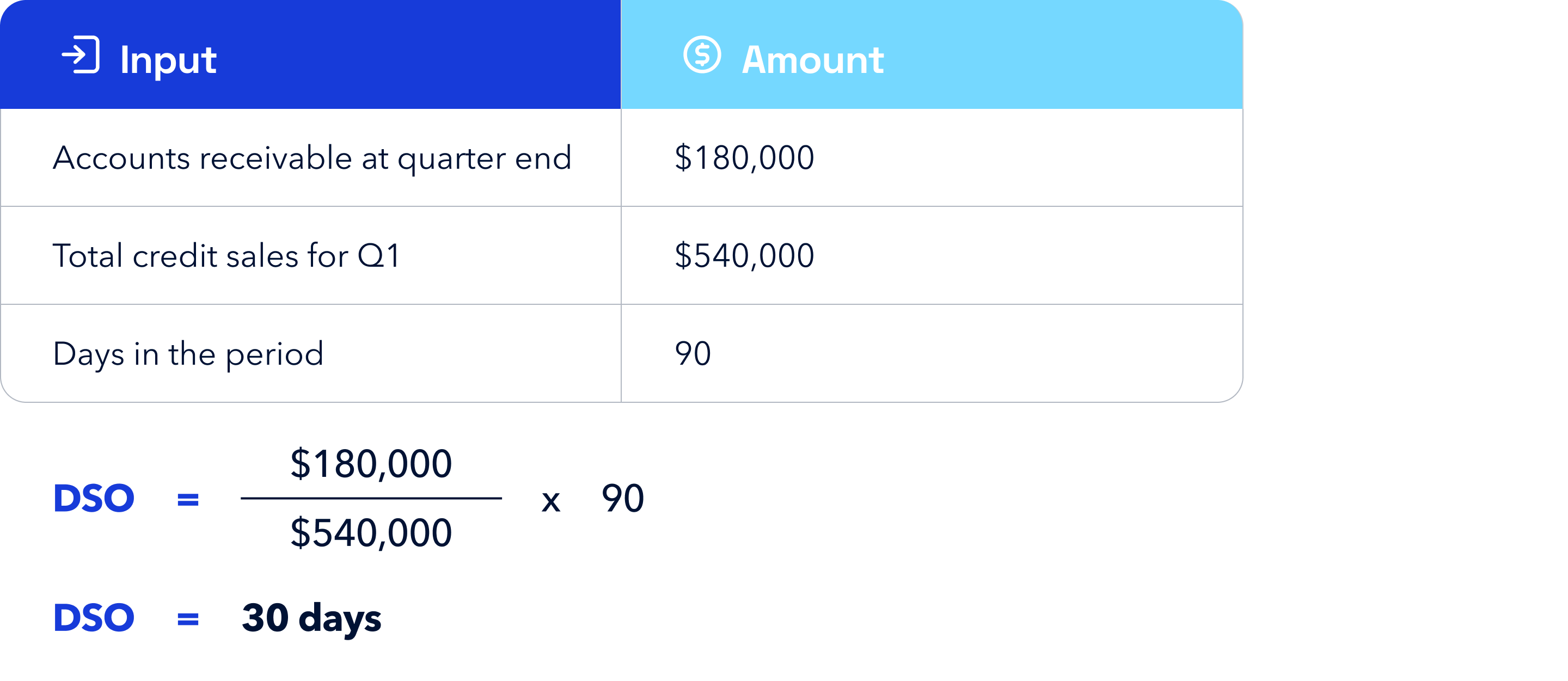
Against Net 30 terms, that is exactly where DSO should land. Now run the same scenario with $270,000 in AR: DSO becomes 45 days, meaning $90,000 is sitting in receivables instead of the bank, persistently.
Monthly vs rolling 12-month DSO
Monthly DSO catches problems quickly before they compound. A rolling 12-month calculation provides a smoothed baseline for leadership reporting and investor conversations. Most finance teams track both, then compare the current month to the same month in the prior year to filter out seasonal distortion.
DSO in Excel
Set up three inputs (AR balance, credit sales, days in period) and apply:
=(AR / Credit_Sales) * Days
Build a monthly table and plot DSO as a trend line. A consistent upward move over three or more consecutive months warrants investigation, even if the absolute number still looks acceptable.
DSO vs related metrics: AR turnover, DPO, and CCC
AR turnover ratio vs DSO
The accounts receivable turnover ratio and DSO express the same relationship two different ways. AR turnover counts how many times the AR balance converts to cash in a year. DSO translates that into days. A business with an AR turnover ratio of 6 has a DSO of roughly 61 days (365 / 6). Finance teams generally find DSO more intuitive; annual reports often show both.
Is DSO the same as “average collection period”?
Yes. Average collection period (ACP) and days sales outstanding describe the same calculation. ACP is common in academic finance contexts; DSO is the term used in corporate finance and AR operations. The naming difference does not reflect a methodological difference.
DSO, DIO, and DPO in the cash conversion cycle
|
Component |
What it measures |
Goal |
|
DSO |
Days to collect from customers |
Minimize |
|
DIO (days inventory outstanding) |
Days to sell inventory |
Minimize |
|
DPO (days payable outstanding) |
Days to pay suppliers |
Maximize within terms |
|
CCC |
Total days to convert operations to cash |
Minimize |
Reducing DSO and DIO while extending DPO within payment terms shortens the CCC and improves liquidity without additional borrowing.
What is the difference between DSO and accounts receivable?
AR is a balance sheet account showing what customers currently owe. DSO is a performance metric derived from that balance. AR tells you the size of the outstanding pile; DSO tells you how long it has been sitting there. Both are necessary for a complete picture of accounts receivable health, but they answer different questions.
What is a good DSO ratio and industry benchmarks
General DSO benchmark ranges
A good DSO does not significantly exceed your standard payment terms. The practical rule: DSO should stay within 20% of the terms you offer. If you invoice on Net 30, a DSO of 30 to 36 days is strong. Beyond 36 days, the gap between what was promised and what is being collected starts to compound.
|
DSO vs payment terms |
What it typically indicates |
|
At or below payment terms |
Strong collections, healthy liquidity |
|
Up to 20% above terms |
Minor gap; monitor the trend |
|
20 to 50% above terms |
Collections or credit issue; take action |
|
More than 50% above terms |
Significant cash flow risk; process review needed |
DSO by industry
According to Upflow's State of B2B Payments 2024 report, the overall median DSO across B2B industries is 56 days. Engineering and construction companies report averages near 100 days. Food and staples retail averages closer to 11 days. The gap reflects differences in payment terms, invoice complexity, and customer type rather than collections quality alone.
Within B2B, SaaS businesses typically achieve lower DSOs than services companies in the same sector. Upflow's data shows that cloud and IT infrastructure SaaS companies average 50-day DSO versus 59 days for services companies in the same vertical.
The right benchmark is always peer-set and trend-based. A 60-day DSO in construction can represent excellent performance; the same figure in SaaS signals a problem worth solving.
What DSO tells you about cash flow and business health
High DSO vs low DSO
A low DSO means the business collects quickly and working capital is available. A high DSO means cash is accumulating in receivables. The risk intensifies when a high DSO coincides with customer concentration, because one large delayed payment can create acute liquidity pressure.
Warning signs that DSO is becoming a strategic concern:
- Rising consistently over three or more months while sales hold steady
- Significantly above industry peers when controlling for payment terms
- An aging report showing growing balances beyond 60 days overdue
- Increasing write-off rates alongside a rising DSO trend
How CFOs and investors use DSO
CFOs use DSO to anchor cash flow forecasting. A stable, predictable DSO lets finance teams project monthly inflows with confidence and make more decisive calls about hiring, capital expenditure, and cash management.
Investors and lenders monitor DSO because it reflects revenue quality, not just volume. A company with $10 million in revenue and 90-day DSO has less practical liquidity than one with $8 million and 30-day DSO. Rising DSO can also signal that credit terms are being loosened to sustain growth, which increases future write-off exposure. J.P. Morgan's analysis of AR receivable days across the S&P 1500 showed receivable days lengthening in 2023 before improving again in 2024, underscoring why tracking the trend matters as much as the absolute number.
Common causes of high DSO
When it comes to bookkeeping and DSO, accountants rely on regular tracking to help identify trends and potential payment issues. What does it mean when your firm tells you that you have a high DSO?
Operational causes
The most frequent internal drivers of high DSO:
- Delayed invoice delivery: invoices sent days or weeks after delivery push the payment timeline back by the same amount
- Invoice errors: billing mistakes trigger disputes that freeze payment until resolved
- Weak credit policies: extending credit without adequate risk assessment invites slow payment and write-offs
- No defined escalation sequence: without structured follow-up, invoices age past due before outreach begins
Customer behavior and payment terms
Extended net terms structurally inflate DSO. Net 90 performance that looks healthy against those terms will produce a high number compared to a competitor on Net 30. Before treating high DSO as a process failure, confirm it is not simply a reflection of deliberate term strategy.
Economic conditions also play a role. According to CreditPulse's DSO benchmarks analysis, average DSO increases 15 to 25% across industries during economic downturns, as customers delay payments to manage their own cash. Strong accounts receivable process discipline matters most precisely when economic conditions create pressure to let things slide.
How to improve and reduce days sales outstanding
Tighten credit and invoicing practices
Improvement starts upstream. Set minimum credit standards for new customers, review credit limits for existing accounts annually, and send invoices the same day a product ships or a service is delivered. Include all required purchase order references and payment instructions upfront. Every reason a customer has to dispute or delay is a reason DSO extends.
Automate collections follow-up
AR automation is the highest-ROI lever available to most finance teams. According to CreditPulse, companies using automated payment reminders collect receivables 12 to 18 days faster than those relying on manual processes. Automated dunning sequences that trigger at defined intervals (before due date, at due, 14 days overdue, 30 days overdue) create the kind of consistent cadence that manual teams cannot sustain across a full customer base.
Plooto's accounts receivable automation software connects invoice delivery, reminders, and cash application in one workflow, so collections keep moving without manual intervention at every step.
Remove friction from the payment experience
Businesses that only accept checks or wire transfers make customers do more work to pay. Expanding to ACH, EFT, and card payments removes common barriers. Offering four or more payment methods reduces DSO by 5 to 8 days compared to check-only billing. Plooto's credit card acceptance feature makes it practical to offer card as a standard option, even for businesses that have not traditionally processed card transactions.
Early payment discounts also work well for accounts with a history of delays. A small discount for payment within 10 days (2/10 Net 30 is a common structure) gives customers a financial reason to act quickly. The cost of the discount is typically lower than the carrying cost of a receivable held for the full term.
DSO in financial strategy and reporting
DSO in the order-to-cash cycle
DSO captures the back half of the order-to-cash (OTC) cycle, from invoice issuance to cash receipt. Poor performance upstream, such as late delivery confirmation, incorrect billing, or disputed line items, always shows up in DSO because it delays the payment trigger. Teams focused on reducing DSO need to look at the entire cycle, not just collections outreach.
How to build a useful DSO report
A monthly DSO report that drives action includes current DSO, prior month DSO, the same period from the prior year, and a trailing 12-month trend line. Adding the aging distribution alongside DSO turns a single number into a diagnostic tool showing whether the issue is concentrated in a few large accounts or distributed across the portfolio.
Segmenting DSO by customer tier, region, or payment channel reveals where the real challenge is. An aggregate DSO of 35 days could be masking a single customer segment running at 75 days. That level of detail is what makes DSO actionable rather than just reportable. Combining DSO with the accounts receivable aging analysis gives the clearest picture of where to focus collections effort first.
From metric to action: using DSO to improve cash flow
DSO is one of those metrics that tells a clear story once you know how to read it. A steady DSO close to your payment terms says the AR process is working. A rising trend says something needs attention, whether that is an invoicing problem upstream, a credit policy that is too lenient, or a collections workflow letting accounts age past the point of easy recovery.
The businesses with the lowest DSO are not the most aggressive collectors. They are the most systematic: accurate invoicing, consistent follow-up, and multiple ways for customers to pay without friction.
Plooto helps finance teams and accounting firms build that system, automating the invoice-to-cash cycle so collections run consistently without requiring manual effort at every step.
Ready to get smart about your DSO? Start a free trial to see how Plooto supports faster, more predictable cash collection.
Frequently asked questions
What does DSO stand for?
DSO stands for days sales outstanding: the average number of days it takes to collect payment after a credit sale.
What is a good DSO?
A DSO within 20% of your standard payment terms is generally considered good. On Net 30, a DSO of 30 to 36 days is strong. Because benchmarks vary widely by industry, compare against sector peers rather than a single universal standard.
What is the DSO formula?
DSO = (Accounts Receivable / Total Credit Sales) x Number of Days in Period.
What does a high DSO mean?
High DSO means the business is taking longer than expected to collect after sales. It signals reduced liquidity and may indicate credit policy, invoicing, or collections issues.
What causes DSO to increase?
Late invoice delivery, billing errors that trigger disputes, extended payment terms, customers paying late, and weak collections follow-up. Economic downturns push DSO up across most industries as customers manage their own cash more carefully.
How do you reduce DSO?
Invoice immediately at delivery, automate payment reminders, tighten credit policies, offer multiple payment methods, and resolve disputes quickly. Automated reminders alone reduce collection time by 12 to 18 days on average.
What are 3 tips to improve DSO through bookkeeping?
- Prompt Invoicing: Invoicing immediately after a sale reduces the time to collect.
- Efficient Accounts Receivable: Accurate, timely recording of deposits and payments reduces errors.
- Credit Policy Review: Analyzing which customers have the highest DSO allows for stricter credit terms for slow-paying clients.
Is DSO the same as average collection period?
Yes. The names differ by context, but the calculation formula is identical.
What is the difference between DSO and CEI?
DSO measures speed: how long collections take. CEI (collection effectiveness index) measures success rate: what percentage of collectible receivables were actually collected. Both metrics together give a more complete picture of AR performance than either one alone.