

Discover how to calculate CEI, benchmark performance, and improve AR collections with this essential KPI finance teams overlook.
Key takeaways
- The collection effectiveness index (CEI) measures what percentage of available receivables were actually collected in a given period, giving a more reliable picture of collections performance than days sales outstanding (DSO) alone.
- A CEI score above 80% is generally considered strong performance. Scores approaching 100% indicate near-total collection of available receivables within terms.
- CEI resists distortion from sales volume spikes, making it a more accurate effectiveness benchmark than DSO during high-growth periods.
- 91% of mid-sized firms with fully automated AR systems report increased savings, cash flow, and growth (Revelwood, 2024), making automation one of the highest-leverage ways to improve CEI.
- Plooto is popular for helping accounting teams automate accounts receivable and can reduce manual follow-up, accelerate collection, and build the consistent workflows that drive CEI improvement over time.
What is the collection effectiveness index (CEI) and why finance leaders should care
The collection effectiveness index (CEI) is an accounts receivable (AR) metric that measures what percentage of outstanding receivables a business successfully collected during a given period, relative to what was actually available to collect. It answers a direct question: of all the money customers owed within terms, how much came in?
What does CEI stand for and how does it measure collection quality?
CEI stands for collection effectiveness index. Unlike metrics that measure timing, CEI measures outcomes. It compares what was collected against what was collectible, stripping out balances that are not yet due, so the result reflects actual performance rather than activity alone.
A CEI close to 100% means the team collected nearly all available receivables. A CEI of 60% means four out of every ten collectible dollars went uncollected. That is the kind of clarity DSO rarely provides on its own. For a technical breakdown of how the index is constructed, AccountingTools offers a reliable reference on the calculation methodology.
Why CEI is the most overlooked AR performance metric
The truth is Collection Effectiveness Index is the AR metric most accounting teams are ignoring. Most accountants and teams default to DSO (days sales outstanding) as their primary AR benchmark. DSO is useful, but it has a significant flaw: it is distorted by sales volume. When revenue spikes, DSO can worsen even when collections are performing well, giving a misleading signal.
CEI cuts through that noise. Because it compares actual collections against what was realistically collectible, sales fluctuations do not create the same optical illusion. According to a BILL survey, 46% of SMBs without automated AR software identify delinquent payments as their top concern, and many of those businesses are measuring the wrong things to diagnose the problem.
What is CEI used for in modern finance teams?
CFOs and controllers use CEI to evaluate working capital health, assess collections team performance, and surface systemic process failures. A declining CEI trend points to specific problems worth investigating: loose credit policies, invoicing delays, inadequate follow-up, or customer payment friction. Tracked over time, it becomes a leading indicator of cash flow risk rather than just a lagging scorecard.
How does Plooto help manage CEI?
Plooto acts as an all-in-one automated platform managing both accounts payable (AP) and accounts receivable (AR) to streamline cash flow. Plooto can help improve CEI by automating the invoice-to-cash cycle, which reduces the friction that typically leads to uncollected debt.
Collection effectiveness index formula and calculation explained
Collection effectiveness index formula breakdown

Each component:
- Beginning AR: receivables balance at the start of the period
- Credit sales: total sales made on credit during the period
- Ending total AR: all receivables outstanding at period end, including overdue balances
- Ending current AR: only receivables still within payment terms at period end
The numerator reflects what was collected. The denominator reflects what was available to collect, excluding balances not yet due. A practical example:
|
Input |
Amount |
|
Beginning AR |
$500,000 |
|
Credit sales during period |
$300,000 |
|
Ending total AR |
$200,000 |
|
Ending current AR |
$150,000 |
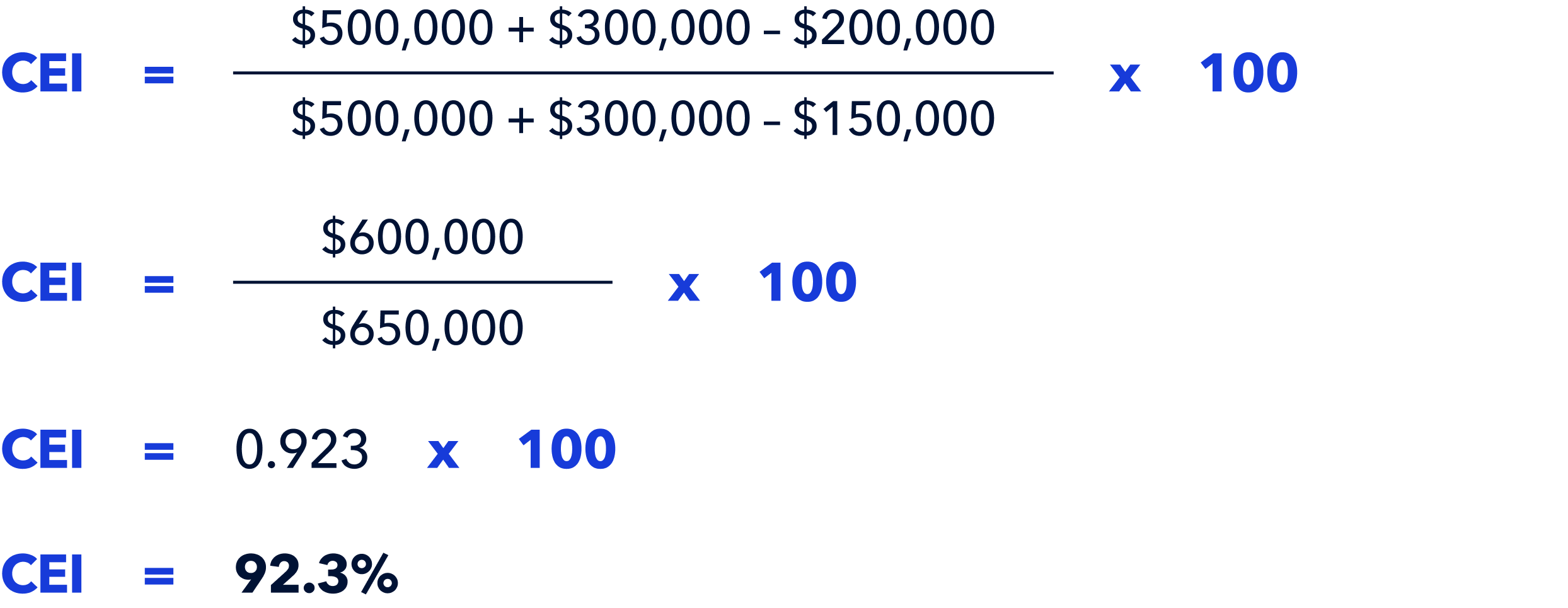
For additional worked examples and formula interpretation, ChaserHQ provides practical CEI guidance built for AR teams.
How is CEI calculated in practice: monthly vs rolling?
Monthly CEI is best for operational decisions, including adjusting collections workflows, escalating at-risk accounts, and evaluating outreach performance. A rolling 12-month CEI smooths out seasonality and provides a more stable benchmark for CFO and leadership reporting. Most finance teams track both.
How to build a CEI calculator in Excel
Set up four columns (beginning AR, credit sales, ending total AR, ending current AR) and apply this formula:
=((B2+C2-D2)/(B2+C2-E2))*100
Track monthly results on a trend line. If outputs look unusual, check the ending current AR input first. Confusing that figure with ending total AR is the most common calculation error.
CEI vs DSO: why collection effectiveness beats speed metrics
DSO vs CEI explained in simple terms
DSO measures how long it takes, on average, to collect payment after a sale. CEI measures whether collections happened at all. One is a speed metric; the other is a success rate. Both matter, but CEI is the more accurate reflection of collections quality.
|
Metric |
What it measures |
Distorted by sales spikes? |
Best used for |
|
DSO |
Average days to collect |
Yes |
Speed benchmarking |
|
CEI |
% of available receivables collected |
No |
Effectiveness assessment |
|
AR turnover ratio |
How often AR converts to cash |
Partially |
Annual performance review |
|
Average collection period (ACP) |
Average days to collect |
Yes |
Industry comparisons |
High DSO paired with high CEI suggests slow but thorough collections. Low CEI signals that receivables are going uncollected, regardless of speed. Used together, the two metrics are far more informative than either one alone.
What is a good collection effectiveness index? Benchmarks and targets
What is a good CEI score?
A CEI above 80% is generally considered strong. Scores of 90% or higher indicate a high-functioning collections operation. Industry data from the National Association of Credit Management (NACM) and related research suggests the average CEI ranges from 70% to 85% depending on sector and context.
|
CEI score |
What it could indicate |
|
90–100% |
Excellent: nearly all available receivables collected within terms |
|
80–89% |
Strong: effective process with minor gaps |
|
70–79% |
Moderate: improvement opportunity in follow-up or credit policy |
|
Below 70% |
Concerning: systemic issues likely |
|
Below 50% |
Critical: collections process needs immediate review |
Collection effectiveness index benchmarks by industry
B2B companies with longer payment cycles, including construction, professional services, and healthcare, tend to see more CEI variability. According to NACM and Dun and Bradstreet payment data, collection probability drops to around 70% at 90 days past due and roughly 50% at six months. The Credit Research Foundation provides detailed guidance on benchmarking receivables collectability by aging bucket, and that deterioration curve is precisely why timely follow-up matters so much to maintaining a healthy CEI score.
Software and subscription businesses typically achieve higher CEI scores because payment terms are standardized and often automated. Professional services firms and manufacturers face more volatility based on client concentration.
How to track CEI over time
A single CEI figure is a snapshot. Trend data is where the value lives. Establish a 12-month baseline, then set improvement targets of 3 to 5 percentage points per quarter when process changes are being made. Early warning signs of deteriorating CEI include growing 60-plus-day aging balances, rising dispute volumes, and increasing write-off rates.
Key drivers of collection effectiveness index performance
Credit policies and risk management
CEI performance starts before an invoice is issued. Clear credit evaluation criteria, including creditworthiness checks, credit limits tied to risk profiles, and defined payment terms, build a stronger foundation for collections. Extending credit to high-risk customers without controls is one of the most direct ways to suppress CEI over time.
Billing accuracy and invoicing speed
An inaccurate invoice creates a collections delay. When customers receive invoices with errors, they dispute them, and disputes freeze collections. Sending invoices immediately after delivery, rather than batching them, compresses payment timelines. Automated accounts receivable systems that generate and deliver invoices programmatically eliminate the delays manual processes introduce.
Collections execution and follow-up strategy
Even the best credit policies and accurate invoices cannot compensate for weak follow-up. The most effective collections workflows use a structured escalation sequence:
- Automated payment reminder 7 days before due date
- Follow-up at due date if unpaid
- Outbound contact at 15 to 30 days past due
- Escalation to a senior contact at 45 to 60 days
- Formal demand and third-party escalation at 90-plus days
According to the Atradius Payment Practices Barometer and NACM research, automated reminders at 7 and 14 days past due, followed by personal outreach at 30 days, form the most effective baseline sequence for B2B collections.
How to improve collection effectiveness index (CEI) quickly
Automate accounts receivable processes
AR automation is the highest-leverage improvement most accounting teams can make. According to a 2024 Revelwood survey, 91% of mid-sized firms with fully automated AR systems report increased savings, improved cash flow, and growth. PYMNTS.com research found that 62% of firms implementing AR automation saw measurable DSO reductions, and CEI improvements typically follow.
Accountants and bookkeepers managing multiple client relationships benefit most from automation because it enforces a consistent collections process across all accounts without adding headcount.
Optimize the payment experience for customers
When customers find it inconvenient to pay, they delay. Limited payment options, clunky portals, and mismatched payment preferences all slow collections. Offering ACH, card, and digital payment alongside traditional EFT gives customers the ability to pay how they prefer.
Plooto's pay by card feature lets businesses accept card payment. Plooto Express accelerates fund delivery, so businesses are not waiting days after collection is technically complete. Removing payment friction is one of the fastest ways to improve CEI without changing credit policy.
Improve collections prioritization and workflows
Not every overdue account needs the same level of attention. Accounts in the 60-to-90-day aging bucket that have not been escalated are often the highest-ROI target: still collectible, but at real risk of sliding further. Aligning collections workflow to accounts receivable aging buckets and customer risk scores ensures effort goes where it has the most impact.
CEI limitations: what the metric doesn't tell you
Where CEI falls short vs aging reports
CEI is a summary metric. A business could achieve a solid CEI of 82% while carrying concentrated exposure to one large, overdue customer, a risk that aging reports reveal but CEI does not. Always run aging reports alongside CEI to see where overdue balances are distributed, not just how much was collected in aggregate.
Historical nature and common calculation errors
CEI reflects what already happened and offers no forward-looking signal. Pairing it with predictive analytics, specifically tools that model payment probability based on customer history, fills that gap.
The most common CEI calculation mistakes:
- Confusing ending total AR with ending current AR: these are not interchangeable; mixing them corrupts the denominator
- Including write-offs in AR balances: written-off amounts should be excluded; including them inflates CEI
- Inconsistent calculation periods: comparing monthly CEI to quarterly CEI without adjusting inputs produces misleading trends
Building a modern AR KPI framework around CEI
A single metric rarely tells the full story. CEI performs best anchoring a multi-metric AR dashboard:
- CEI: primary collections effectiveness percentage
- DSO: average days to collect (speed benchmark)
- AR turnover ratio: how often AR converts to cash annually
- Average collection period (ACP): average days to collect, useful for industry comparisons
- Bad debt as % of revenue: credit management health indicator
- Aging distribution: breakdown of receivables by 30/60/90-plus day buckets
Report CEI to leadership monthly alongside DSO and the aging summary. A 12-month trend line is often more useful than any single data point. When CEI is tracked consistently, it feeds directly into cash flow forecasting. If a business reliably achieves 88% CEI, that figure anchors monthly collection projections with more confidence than gut feel or DSO alone.
CEI and AR automation: what technology changes
AR automation improves CEI by eliminating the manual bottlenecks that allow receivables to age. Automated invoice delivery, payment reminders, escalation sequences, and cash application all reduce the gap between when money is due and when it arrives.
Plooto's QuickBooks integration and broader integrations ecosystem connect payment automation directly to the accounting software teams already use, eliminating manual data entry and ensuring every collected payment is reconciled without additional effort. For firms managing multiple clients, that is what makes a consistent, scalable AR process possible.
Aberdeen Group research indicates that best-in-class companies achieve 80% faster payment clearance through automation. AI-enhanced collections extends that advantage by scoring accounts, predicting payment risk, and routing outreach to the most effective channel, shifting collections from reactive to proactive.
From metric to momentum: making CEI your AR performance anchor
The collection effectiveness index cuts through the noise that sales volume creates in traditional AR reporting. It isolates what was collectible from what was collected, and gives finance teams an honest read on how much earned revenue is actually making it into the bank.
Getting started requires no new software. Pull the four required data inputs from your accounting system, run the formula, and establish a baseline. Track it monthly. Within a few periods, patterns emerge, and those patterns point directly to where the process needs work.
For teams ready to move from tracking to improving, automation is the highest-return investment available. Plooto helps businesses automate AR workflows, remove payment friction, and connect collections processes directly to QuickBooks and other accounting platforms, building the foundation for a CEI that improves month after month.
Ready to improve your AR collections process? Start a free trial to see how Plooto supports faster, more consistent collections.
Frequently asked questions
What does CEI stand for? CEI stands for collection effectiveness index, a metric that measures the percentage of available receivables collected in a given period.
What is a good CEI score? A score above 80% is considered good. Above 90% indicates a high-performing collections process. CEI cannot exceed 100% mathematically.
How is CEI different from DSO? DSO measures how long it takes to collect payment. CEI measures whether collections happened at all. CEI is a success rate; DSO is a speed metric. Sales volume spikes distort DSO but not CEI, making CEI the more reliable standalone effectiveness benchmark.
How Can Plooto Impact Your CEI? Plooto helps improve your CEI by automating the "Invoice-to-Cash" cycle, which reduces the friction that typically leads to uncollected debt.
How often should CEI be calculated? Monthly for operational decisions. Rolling 12-month for leadership reporting and strategic benchmarking. Most finance teams track both.
What causes a low collection effectiveness index? Common causes include loose credit policies, delayed invoicing, weak follow-up cadences, limited payment options, high dispute rates, and manual AR processes. Each can be addressed through process improvement and automation.
Can CEI be used for cash flow forecasting? Yes. A stable historical CEI allows teams to apply a consistent collection rate to projected collectible AR, building more reliable monthly cash flow models.
What is the NACM benchmark for CEI? Industry data from NACM and related research places the average CEI between 70% and 85%, with variation by sector, payment terms, and business model. Best-in-class performers typically operate above 90%.
How does AR automation improve CEI? Automation removes manual delays in invoice delivery and follow-up, creates consistent outreach cadences, offers customers more payment options, and ensures cash application happens immediately. According to a 2024 Revelwood survey, 91% of mid-sized firms with fully automated AR systems report improved cash flow and growth.