
What is 3-way matching in accounts payable?
How three-way matching improves payment accuracy and how automation streamlines the process, reducing labor, errors, and expenses.
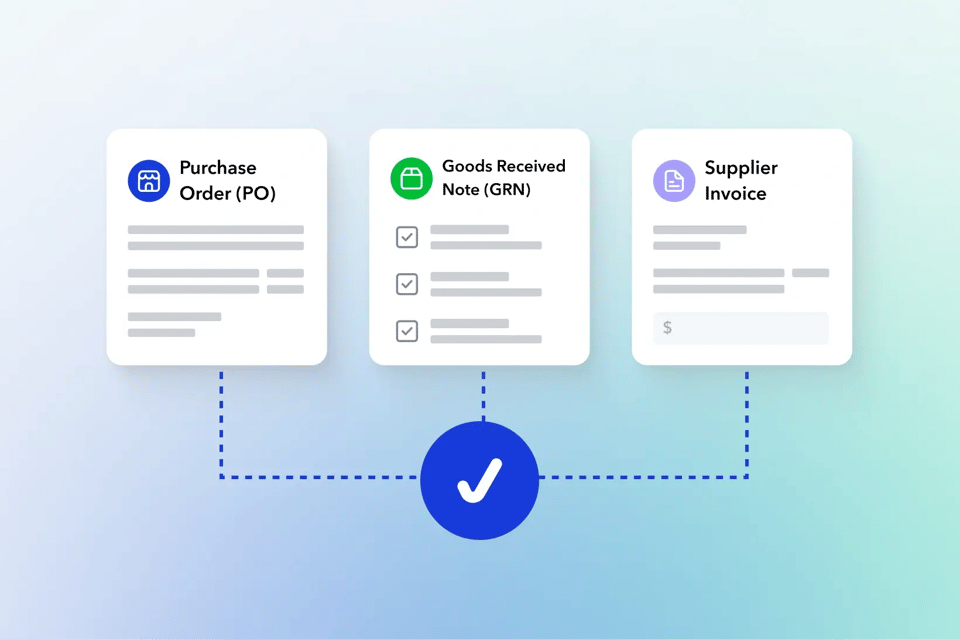
Three-way matching in accounts payable is a control that compares a purchase order, a goods received note (or receiving report), and a supplier invoice before the invoice is approved for payment. It confirms the business ordered, received, and was billed for the same goods or services at the agreed quantities and prices, so AP teams do not pay for items that were never ordered, never delivered, or billed incorrectly. When the three documents disagree, the invoice is held and the difference is investigated under the organization's matching and approval rules.
That check matters because invoice fraud and billing errors are common, and a reliable match process creates a cleaner audit trail, more accurate payments, and fewer supplier disputes. In the 2025 AFP Payments Fraud and Control Survey, 79% of organizations reported attempted or actual payments fraud in 2024, and 45% reported vendor impersonation. Three-way matching will not stop every scheme, but it makes it much harder to pay for goods that were never ordered or never arrived.
For finance teams, accounts payable professionals, procurement staff, and accounting firms managing accounts payable, the catch is effort. Done by hand, three-way matching is slow and labor-intensive, which is why many teams pair it with automation.
Below, we cover what a 3-way match is, when to use it, how the process works step by step, a worked example with pass and fail outcomes, what to do when a match fails, how it compares with two-way and four-way matching, how SAP, Oracle, and NetSuite handle it, and where automation and best practices fit.
Key takeaways
- Three-way matching compares the purchase order (PO), goods received note (GRN), and supplier invoice before payment is approved, so the business only pays for what it ordered and received.
- A failed match is an exception, not proof of fraud. Partial deliveries, price changes, and data-entry errors are common causes, and each needs a documented resolution.
- Two-way, three-way, and four-way matching suit different risks. Three-way matching is a common default for physical goods, while two-way and four-way matching fit lower-risk or quality-critical purchases.
- Manual matching is time-consuming and delays payments, which can strain supplier relationships.
- Automation reduces manual work across the AP cycle. Plooto helps finance teams and accounting firms capture invoices, route them through multi-level approvals, and pay suppliers from one platform that syncs with QuickBooks, Xero, and NetSuite.
What is a 3-way match in accounts payable?
A 3-way match is a verification check that confirms three records agree before a supplier is paid: what the buyer ordered (the purchase order), what the buyer received (the goods received note), and what the supplier billed (the invoice). If supplier, item, quantity, and price line up across all three, the invoice can move to approval.
Three-way matching in accounts payable is the step where the AP team verifies an invoice against its purchase order and receipt record before releasing payment. Businesses that use it only pay invoices that pass this check or that an authorized person has approved as an exception.
Two-way matching only compares the invoice with the PO. It confirms the bill reflects the agreed order, but it cannot confirm the goods actually arrived. Adding the goods received note closes that gap, which is why three-way matching is the more reliable way to detect overbilling, short shipments, and fraudulent invoices.
The concept of three-way matching as an internal control
The core concept of three-way matching is independent verification. Three different records, usually created by three different people or departments, must tell the same story before money leaves the business:
- Purchasing creates the PO, which sets the agreed terms.
- Receiving records what physically arrived, independent of what the supplier claims to have shipped.
- Accounts payable compares the supplier's invoice with both records.
Because no single person controls all three documents, three-way matching supports segregation of duties, a basic internal control. That matters: the ACFE's 2024 Occupational Fraud Report found billing schemes in 22% of cases, with a median loss of $100,000, and identified a lack of internal controls as the most common contributing factor (32% of cases).
Where does three-way matching fit in procurement and the procure-to-pay cycle?
Three-way matching sits at the hand-off between procurement and accounts payable in the procure-to-pay (P2P) cycle. Procurement owns the first part of the cycle (requisition, approval, and the purchase order), receiving confirms delivery, and AP uses the three-way match to confirm the supplier's bill before payment.
That position makes it the main checkpoint between buying something and paying for it. A typical P2P sequence looks like this:
- Requisition and purchase approval
- Purchase order issued to the supplier
- Goods or services received and recorded
- Supplier invoice received
- Three-way match performed
- Invoice approved and payment scheduled
- Payment recorded and reconciled
Weak matching undermines everything procurement negotiated upstream. Agreed prices and quantities only protect the business if AP checks them before paying.
How the 3-way matching process works
The three-way matching process works in six steps, moving from the purchase order through receipt, invoice comparison, and exception handling to payment approval:
- Create and approve the purchase order (PO). The buyer records the supplier, items or services, quantities, agreed prices, and a PO reference number before placing the order.
- Record receipt of goods or services. The receiving team confirms what actually arrived and records accepted quantities in a goods received note (GRN) or receiving report. For services, an appropriate service confirmation from the person who received the work takes the place of a GRN.
- Receive the supplier invoice. Accounts payable captures the invoice and links it to the matching PO number and receipt record, ideally starting the comparison as soon as invoices arrive.
- Compare the three records. AP checks that the supplier, item or service, quantities, unit prices, and totals agree across the PO, GRN, and invoice, subject to the organization's matching rules, helping prevent overpayments and fraud in accounts payable before payment approval.
- Resolve exceptions. If details do not agree, AP holds the invoice and routes it for review to confirm whether the difference reflects a partial delivery, pricing error, missing receipt, or approved tolerance.
- Approve and schedule payment. Once the match passes, or an authorized exception is resolved, the invoice goes through the required approval process and payment is scheduled under the agreed terms.
Note that the order of steps 2 and 3 can vary. Suppliers do not wait for the buyer's GRN before invoicing, and an invoice often arrives before the goods. The control is not the sequence of documents; it is the comparison that happens before approval and payment.
Who is responsible for a 3-way match?
The buyer's accounts payable team is responsible for performing the 3-way match before approving payment or releasing funds, but the control depends on three groups. Purchasing owns the PO, receiving owns the GRN, and AP owns the comparison and the exception follow-up, with separate responsibility for ordering, receiving, and approving payment strengthening the control. An approver with the right authority signs off on exceptions.
For accounting firms and outsourced bookkeepers managing AP for clients, the same split applies. The firm typically performs the match and flags exceptions, while the client confirms receipts and approves anything outside policy.
An example of 3-way matching
To demonstrate 3-way matching in action, here is a hypothetical example of a real-world purchase.
- A train-manufacturing company, GoTrainGo, wants to offer more remote positions to employees. To equip them, it plans to order 150 headset microphones at $200 each, an expected purchase of $30,000 before any separately agreed charges or taxes.
- GoTrainGo creates a purchase order listing the quantity and price per item and sends it to the supplier, GoHeadsetGo Inc.
- GoHeadsetGo ships the headsets. GoTrainGo's receiving department inspects the shipment and records the accepted quantity and condition in a goods received note.
- GoHeadsetGo sends an invoice referencing GoTrainGo's PO number.
- GoTrainGo's AP team compares the PO, GRN, and invoice line by line.
- GoTrainGo either approves the invoice for payment or holds it to investigate any discrepancy, depending on the result of the 3-way match.
3-way matching example outcomes: Pass vs. fail
Here is how the same purchase plays out under three different scenarios:
|
Scenario |
PO |
Goods received note |
Invoice |
Result |
Next step |
|
Successful match |
150 at $200 ($30,000) |
150 accepted |
150 at $200 ($30,000) |
Pass |
Proceed to normal approval |
|
Quantity mismatch |
150 at $200 ($30,000) |
140 accepted |
150 at $200 ($30,000) |
Fail |
Investigate the 10-unit gap; received value is $28,000 |
|
Price mismatch |
150 at $200 ($30,000) |
150 accepted |
150 at $210 ($31,500) |
Fail |
Confirm an authorized price change or request a corrected invoice for the $1,500 variance |
In the quantity mismatch, AP applies the company's partial-invoice policy before approving anything; for example, a supplier might bill for 150 units even if only half of the order arrived, which is why partial-receipt checks matter. In the price mismatch, AP checks whether a price change was agreed and documented.
Neither failure automatically means fraud. A discrepancy can just as easily come from human error, such as a supplier entering the wrong unit price or a receiving clerk miscounting a pallet.
What happens when a three-way match fails?
When a three-way match fails, the invoice, purchase order, and receipt record do not agree under the buyer's matching rules. AP should not have the invoice approved automatically. Instead, it should identify the type of exception and route it to the right owner.
The most common three-way match exceptions and how to handle them:
|
Mismatch |
Example |
Typical next action |
|
Quantity |
Invoice bills 150 units; only 140 accepted |
Check for a partial receipt or backorder; confirm whether partial invoicing is allowed |
|
Price |
Invoice says $210 per unit; PO says $200 |
Check the contract or an authorized price change; request a correction if needed |
|
Missing receipt |
Invoice arrives before goods are recorded |
Wait for receiving confirmation or investigate the missing record |
|
duplicate invoices |
Same supplier invoice number appears twice |
Investigate the potential duplicate before any payment |
|
Within tolerance |
Small authorized rounding or freight difference |
Apply documented tolerance and approval rules |
Document the resolution and approval trail before releasing payment. Unresolved exceptions can create bottlenecks and delayed payments if they are not routed quickly. Tolerances, escalation paths, and payment holds depend on company policy and system configuration.
What is a matching tolerance in three-way matching?
A matching tolerance is a pre-approved variance that lets an invoice pass the 3-way match even when the numbers are not identical. For example, a policy might allow a price difference of up to 1% or a small fixed dollar amount to cover rounding or freight. In automated workflows, these rules can reduce unnecessary manual review for small, acceptable variances.
Tolerances keep tiny differences from clogging the exception queue. Set them deliberately, though. A tolerance that is too loose lets real overbilling slip through, and every tolerance rule should be written down so auditors can see why an invoice passed.
The advantages and disadvantages of 3-way matching
Three-way matching gives businesses stronger payment controls and cleaner records, but it adds work, especially when done manually. Understanding both sides helps teams decide where to apply it and where to automate.
Benefits of 3-way matching
- A more accurate payment process. Verifying each invoice against the PO and receipt improves payment accuracy by catching overbilling and short shipments before they become overpayments.
- Reduced billing fraud risk. Checking invoices against independently created records makes fake or inflated invoices much harder to pay, helps prevent overpayments and fraud in accounts payable, and can stop duplicate payments before funds leave the business, especially when combined with other controls against common fraud risks like vendor impersonation.
- Cost savings. Catching discrepancies before payment avoids the time and effort of clawing money back later. Suppliers may also offer early-payment discounts to businesses that approve invoices quickly.
- Audit readiness. Matched documents create a clear record of what was ordered, received, and paid, with organized files that are easier to retrieve during external audits. In Canada, the CRA generally requires businesses to keep records and supporting documents for six years from the end of the last tax year they relate to, and a matched PO, GRN, and invoice set is exactly the kind of support auditors ask for.
- Stronger supplier relationships. Suppliers value customers who issue accurate POs, resolve disputes quickly, and pay on time, which can also support better vendor relationships.
Disadvantages of manually executing the 3-way matching process
Three-way matching presents real challenges, especially when businesses run it manually:
- A labor-intensive system. With manual processing, pulling three documents, comparing line items, and chasing discrepancies takes time. Every exception adds more work and delays payment.
- Strained supplier relationships. Those delays can lead to late payments, missed early-payment discounts, or penalties that erode the savings matching was meant to create.
- Human error. Manual matching can introduce mistakes of its own: 39% of manual invoices contain at least one error, and error rates rise as invoice work stays manual. Misreading a figure or misplacing a receiving report can cause a false exception or, worse, a missed one.
Automation reduces most of these problems, though it does not eliminate them. An AP automation platform can cut manual data entry and speed up routing, and it can lower per-invoice manual costs by about $12-$30, but automated processes still generate exceptions that need human judgment, and the rules behind them still need regular review.
2-way vs 3-way vs 4-way matching
Two-way, 3-way, and 4-way matching differ in how many documents they compare before an invoice is paid. Each adds a layer of verification and a layer of effort, so the right choice depends on the purchase's value and risk.
|
Matching type |
Documents compared |
What it confirms |
Best suited for |
|
2-way matching |
Purchase order + invoice |
The bill reflects the agreed order |
Low-value, recurring, or service purchases |
|
3-way matching |
Purchase order + goods received note + invoice |
The business received what it is being billed for |
Most PO-backed purchases of physical goods |
|
4-way matching |
Purchase order + goods received note + inspection report + invoice |
The goods received also passed quality inspection |
Regulated or quality-critical purchases |
Three-way matching is a common default for physical goods because it balances control and effort, but it is not automatically the right fit for every purchase. Four-way matching adds inspection or quality acceptance, which raises assurance where product quality matters, at the cost of more steps and slower approvals.
When should you use two-way matching instead?
Use two-way matching for frequent, low-value, or repeat purchases where a separate receiving record adds little protection. If your business buys the same supplies every month, your AP team likely knows the costs well enough to spot errors quickly.
Matching fewer documents means faster approvals, which helps improve working capital and metrics like AP turnover ratio.
When should you use 4-way matching instead?
Use four-way matching when the quality of what arrives matters as much as the quantity, as in healthcare equipment, pharmaceuticals, or manufacturing components. The added inspection step confirms the goods meet specifications before payment, and in some service or quality-controlled workflows, an acceptance document serves as the formal sign-off before payment.
In those industries, slower verification can be more cost-effective in the long run, because paying for defective or non-compliant goods costs far more than the extra check.
What is invoice matching?
Invoice matching is the process of verifying a supplier invoice against supporting documents before paying it. It is a core part of invoice management and the broader invoice processing workflow, and two-way, three-way, and four-way matching are all forms of it.
A typical invoice contains six common fields of invoice data that form the basis for the match:
- The name of the vendor
- The name of the buyer
- The goods or services purchased
- The quantity purchased
- The value of the purchase
- The purchase date
Processing every invoice carries a real cost. Ardent Partners' State of ePayables 2025 research puts the average cost to process an invoice at $12.42, compared with $2.65 for best-in-class AP teams. Much of that gap comes from manual handling, including matching and exception follow-up.
How does three-way matching work in SAP, Oracle, and NetSuite?
SAP, Oracle, and NetSuite all support three-way matching, but each handles it through its own settings and terminology. The underlying logic is the same: compare the PO, the receipt, and the invoice, then hold anything outside tolerance.
3-way match in SAP
In SAP, the 3-way match compares each purchase order line item with the goods receipt (GR) and the invoice receipt (IR). The goods receipt posts an open credit to the GR/IR clearing account, and the invoice receipt posts an offsetting debit. As SAP's own training material explains, when amounts and prices match, the system clears them automatically; items that do not match stay open for analysis.
SAP teams can also enable GR-based invoice verification on a PO line so each invoice must reference a specific goods receipt. Invoices that exceed configured tolerances are typically blocked for payment, stay open for analysis, and often require human review before the payment block is removed.
3-way match in Oracle
In Oracle Payables, the match approval level (2-way, 3-way, or 4-way) is set in Purchasing Options and can be overridden at the supplier or purchase order shipment level. Invoice tolerances define the allowable variance between invoices and POs or receipts, and invoices that fall outside them are placed on hold during invoice validation.
3-way match in NetSuite
NetSuite supports 3-way matching when Advanced Receiving is enabled, so item receipts are recorded separately from vendor bills. Bills linked to a PO show variances when quantities or rates differ, and approval workflows can route those bills to an approver. More complex rules, such as automatic approval within a percentage tolerance, may require customization.
Configuration details vary by version and setup in all three systems, so confirm specific behavior with your ERP administrator or implementation partner.
Benefits of automating the matching process
Automated three-way matching replaces manual document pulls and line-by-line comparison with rules the system applies to every invoice, a practical form of process automation that can lower manual processing costs by about $12 - $30 per invoice. For businesses of all sizes, and for accounting firms managing AP across several clients, that shift brings concrete benefits:
- Linked records. Invoices are connected to their PO and receipt as matching documents in the system instead of being hunted down in email or filing cabinets.
- Consistent rules. Tolerances and matching criteria are applied the same way to every invoice, rather than depending on who is reviewing it.
- Exception queues. The system can review routine invoices and surface only exceptions for human attention, so AP time goes where judgment is needed.
- Approval routing. Matched invoices move straight to the right approver, and exceptions go to the person who can resolve them. Invoices that meet the rules can keep moving with no manual intervention. Well-designed approval workflows keep both moving.
- A complete record. Each decision is logged, which strengthens the audit trail and makes year-end reviews faster.
- Faster cycle times. Ardent Partners found best-in-class AP teams achieve 79% faster invoice cycle times than their peers, largely through automation.
The best software for automating the 3-way matching process
The best software for automating 3-way matching fits around your existing systems rather than replacing them. In most businesses, the PO and receipt live in the accounting or ERP system, so the right AP tool needs to work with that data, not create a second version of it, with automated matching comparing invoice, PO, and receipt records.
When evaluating automated systems, look for:
- Two-way sync with your accounting software or ERP
- Invoice capture that reduces manual data entry and improves invoice-matching inputs
- Configurable, multi-level approval workflows
- Exception handling and clear status tracking
- Payment options that match how your suppliers want to be paid
- Multi-client access, if you are an accounting firm managing AP for several businesses
Plooto supports the approval and payment side of that workflow. Teams can import invoices by email or upload, route them through custom multi-level approval workflows, and pay suppliers by EFT, ACH, check, credit card, or international payment.
Plooto integrates with your accounting software, including QuickBooks, Xero, and NetSuite, so approved invoices and payment statuses sync back automatically, helping lower operational costs by reducing manual work per invoice. Accounting firms can manage multiple clients from one account.
Making three-way matching a reliable control, not a bottleneck
Three-way matching works when it is consistent: every PO-backed invoice gets checked against what was ordered and received, every exception has an owner, and every decision leaves a record. The businesses that get the most from it treat the match as a control with clear rules, not a box-ticking step done when someone has time.
Start by documenting your matching rules, tolerances, and escalation paths, then automate the steps around them so AP departments spend time on exceptions instead of paperwork.
Ready to take the manual work out of approvals and payments?
Try Plooto and see how much time your AP process can save.
FAQs
Don't see your question answered here? Contact us today.
How do you test a 3-way match?
What documents are needed for 3-way matching?
What does GRN stand for?
What does P2P mean in three-way matching?
What is the difference between 2-way and 3-way matching in accounts payable?
Is there three-way matching in accounts receivable?
Does every invoice need a 3-way match?
How does three-way matching support an audit?
What happens to an invoice that fails a three-way match?
Further reading
Learn more about popular accounting terms and practices to ensure you're at the top of your game.


Table of contents
 What is a 3-way matching?
Where does three-way matching fit?
How the 3-way matching process works
An example of 3-way matching
What happens when a three-way match fails?
The advantages and disadvantages of 3-way matching
2-way vs 3-way vs 4-way matching
What is invoice matching?
How does three-way matching work in SAP, Oracle, and NetSuite?
Benefits of automating the matching process
The best software for automating the 3-way matching
Making three-way matching a reliable control, not a bottleneck
FAQs
Sign up in minutes.
Start saving hours.
Manage all of your payments in one platform. No jumping between apps necessary.
Start free trialSpeed up and simplify your B2B payments with Plooto — entirely free.
Learn if Plooto is right for you as you scale your business.
Start free trial