
Off the ledger:
Accountants share the fintech they (and their clients) can’t live without
Insights from our 2024 Canadian Accountant Survey

The overwhelming adoption of financial technology (fintech) is reshaping how small and medium-sized businesses (SMBs) operate — and how accounting firms serve them.
We surveyed over 500 Canadian accountants to understand the realities of fintech adoption among small businesses. With 97% of their clients relying on some form of fintech to run their business, bookkeeping processes are forever transformed. But there’s still plenty of room for improvement and optimization.
Too many SMBs still rely on costly manual processes that drain resources and stifle growth. These outdated approaches are partly due to misconceptions about fintech that hold them back from fully embracing tech transformation.
Accountants are uniquely positioned to drive much-needed change.
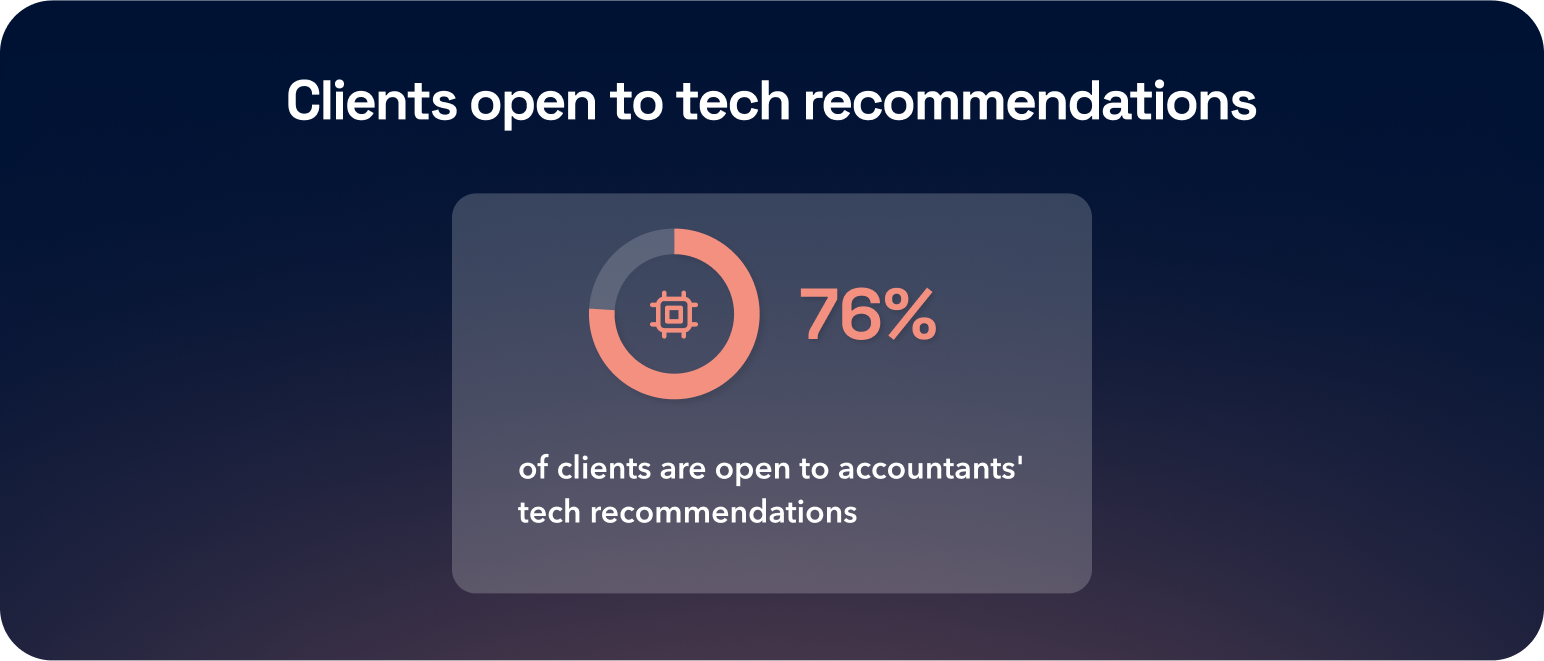
Our survey shows that 76% of clients are somewhat or very open to their accountants' technology recommendations, illustrating the vast opportunity for growth-minded firms.
By guiding clients toward better financial tools and processes, accounting practices will earn trust, strengthen relationships, and open new revenue streams — all while making it easier to accomplish their own day-to-day tasks.
Our findings offer a unique glimpse into how your peers and competitors think their clients can — or should — be using fintech. Understanding these insights and applying the recommendations will make you a valued strategic advisor, driving your practice’s and clients’ success.
Businesses are open to fintech — but there’s room for improvement
Across Canada, most accounting firm clients (97%) use financial technology in their business operations, with a handful of uses being the most popular.
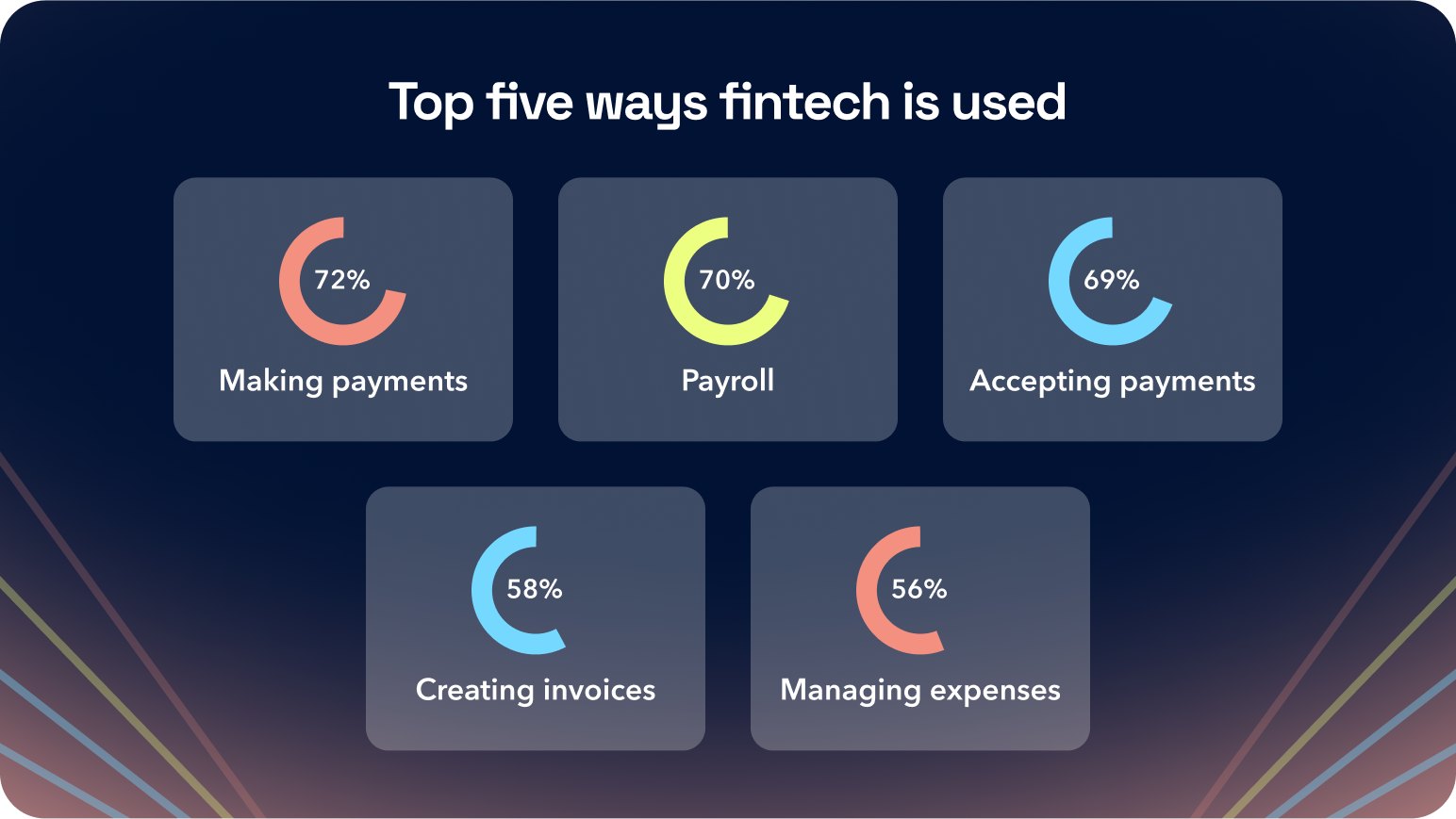
 Making payments
Efficient accounts payable processes are critical for businesses of all sizes, so the ability to make quick, secure payments is often the first step in a business's fintech journey.
 Payroll
 is complex and steeped in compliance requirements, making it an ideal candidate for tech solutions. Automated payroll systems can significantly reduce errors and ensure timely, accurate employee payments.
 Accepting payments
The ability to receive, manage, and accelerate payments is crucial to ensuring a business can access its working capital. This high adoption rate of accounts receivable (AR) tools suggests that businesses are adapting to evolving consumer preferences.
 Set up quarterly fintech performance reviews
Regular check-ins ensure that your recommended solutions are delivering expected benefits. Use these reviews to discuss adjustments to current tools and approaches along with new features or solutions that could further benefit the client.
 Managing expenses
With just over half of clients using expense management software, accountants have room to guide clients towards sound, comprehensive financial management tools.
The considerable costs of underutilizing fintech
While only 3% of respondents’ clients don’t use any form of financial technology, plenty of businesses are just testing the waters — hesitant to fully take the plunge into fintech. And many more don’t realize they’ve picked the wrong software for their needs.
Regardless, business-as-usual manual processes are costing them more and more each day, impacting the efficiency, profitability, and performance of their business — and the accounting firms that serve them.
SMBs: The cost of business as usual
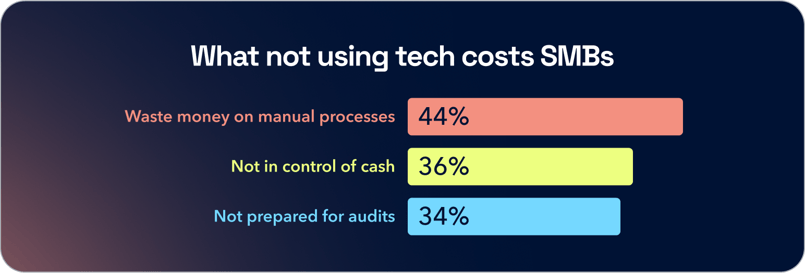
 Spending too much money on manual processes
Manual processes, especially accounts payable and receivable, are expensive and can easily be automated. Why waste money that could be used for growth and innovation?
 Losing control of cash
When SMBs don’t understand their cash flow, they miss opportunities to invest in the next big thing, hire game-changing talent, or expand into potentially profitable new areas. Even worse, 82% of small businesses fail due to cash flow problems.
 Want to future-proof your cash flow? This guide will help you get your finances on track.
 Not prepared for audits
Audits are always stressful and time-consuming, but lack of preparation makes fines, penalties, or damage to the business's reputation more likely.
 AI and automation can help finance teams stay audit-ready. Check out this checklist to learn how.
Accountants: The costs of business-as-usual
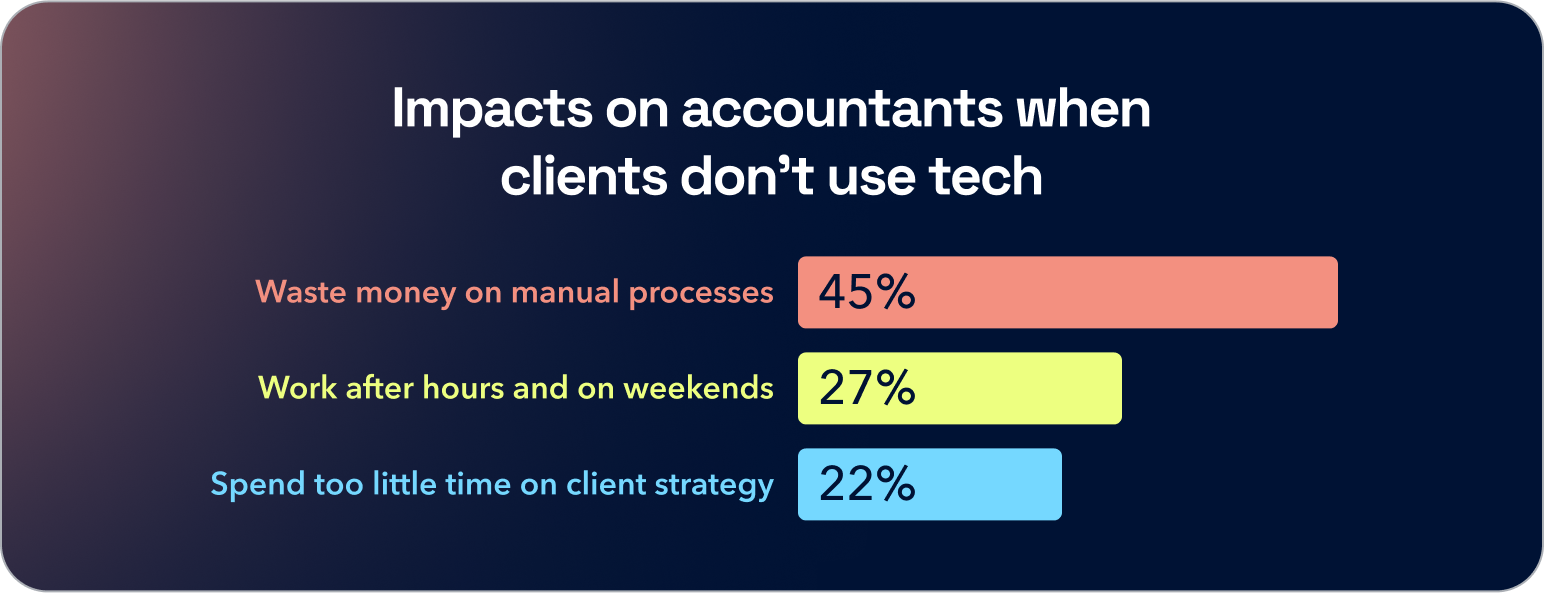
Spending too much time on manual processes
Manual data entry and reconciliation is not just time-consuming and error-prone; it leaves little bandwidth for higher-value activities like advising clients.
 Spending too much time at work
Over a quarter of accountants consistently work after hours or on weekends because their clients haven’t implemented time-saving methods. This overwork can lead to burnout, reduced job satisfaction, and higher turnover rates.
 Spending too little time on client strategy
Accountants who don’t make time to consult with clients lose them. The right financial technologies free accountants from mundane, manual tasks so they can provide more strategic counsel.
The good news is, the time and money wasted on outdated, inefficient processes can be reclaimed with the right fintech solutions. By embracing innovation and automation, businesses can unlock new levels of efficiency, productivity, and profitability.
Why fintech upgrades are a win-win for accountants and their clients
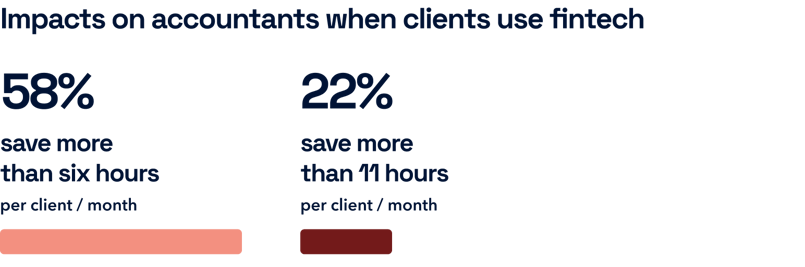
When clients use fintech, how much time do accountants save? More than half of our respondents save six or more hours per month—per client. And nearly a quarter save even more: eleven hours per month per client.
But for some Canadian firms, that’s just the beginning.
For Think Accounting, the switch to automation saved 15 hours and $2,500 a month. “Now, we don’t have to think about invoicing our clients every month,” said Varun Sehgal, partner at Think Accounting. Automating their AR “eliminates paper, smooths out cash flow, reduces AR headache, and so much more.”
Likewise, Enkel’s Founder Omar Visram said every time his firm uses automated AP, they save “time, money, or both.” Visram estimates that adds up to around 100 hours per month.
How would you like to spend 30% less time on AP processes? Watch the video to learn how Enkel Bookkeeping pulled it off.

With dozens of hours reclaimed, fintech is a win-win for accountants and their clients, allowing both to finally unlock their true potential. Here’s how.
1. Fintech accelerates payments, reconciliation, and performance
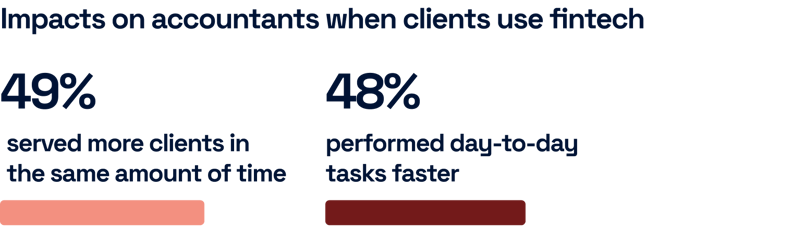
Fintech fast-tracks operations across the entire financial management spectrum. Among the accountants we surveyed, 49% increased capacity and now serve more clients in the same amount of time, while 48% increased performance, completing their day-to-day tasks faster than before.
"Now I can set up complex, automated workflows and approval rules that speed up the payment process," said Jesse Blades, owner of Bear Hill Bookkeeping, adding that streamlining processes allowed him to “take on more NPO clients.”
True North Mortgage was trapped in a never-ending cycle of account reconciliation. Srinivas Pabbaraju, the company’s Controller, said with AR automation, “everything is reconciled, and we don’t have to keep worrying about whether a check will be cashed.”
Manual reconciliation is a time-sucking slog. And missed or delayed payments lead to countless woulda coulda shoulda moments — opportunities that slip by because bookkeepers don’t have a proper handle on client cash flow.
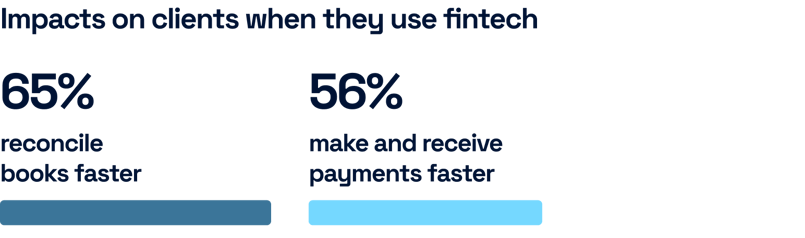
Fintech not only reveals real-time cash flow visibility; 65% of clients can reconcile their books faster, and 56% can make and receive payments faster.
For Freightzy’s accounting team, manual processes “made it hard for us to track and reconcile our payments,” recalled Sean Freedman, President and Founder of the single-source logistics provider. “With Plooto, I now have clarity on cash flow, and it has allowed us to make more informed decisions for the business."
Freightzy ditched traditional payment methods and never looked back. In this video, Founder Sean Freedman explains how — and why.

2. Fintech frees time to focus on growth
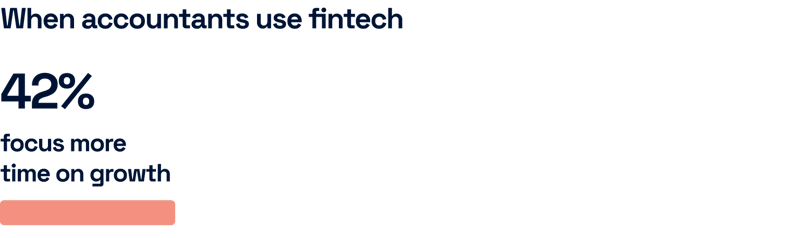
A substantial number of accountants have more time to focus on the growth of their firm and can invest the time they recoup in business development, marketing, or expanding service offerings.
Canadian accounting and bookkeeping practice Envolta grew its revenue 400% after automating its AP processes."It’s a very manual process,” said David DiNardo, the firm’s CEO. ”You have to enter the information into the accounting software. You have to prepare a check. You have to get a signature. You have to mail it out. And then you have to clear the payment afterwards.”
Now DiNardo says, “It’s literally a two-step process and then you’re done. You’re eliminating a manual process with an electronic tool. Way better.”
Accounting clients also gain time to spend on scaling their businesses. “We experienced tremendous growth in our first year,” notes Freightzy’s Freedman, “but we wouldn't have been able to keep up that pace without automating some of our processes.”
3. Fintech makes accounting firms more valuable
Half of the accountants surveyed say financial technology frees them to offer clients more strategic recommendations. As business-critical as bookkeeping services are, clients place a higher value on advice than number-crunching. And they’re much less likely to leave a firm they perceive to be a trusted partner.

James Allen, Partner at MBF Chartered Professional Accountants in Nova Scotia, views improved client service as a core benefit of fintech. "It has allowed us to better serve our external clients as we help them implement and grow their own payment solutions."
Allen is on to something:
64% of accountants actively offer fintech advice when they onboard new clients. It’s advice SMBs want — and an outstanding opportunity for accountants to grow their business.
Four client-friendly ways to expand your advisory services
Accountants can offer several services that not only build their business but also strengthen existing client relationships. While these may seem routine to practitioners, clients find them invaluable.
Offer fintech audits to potential clients
Assess clients' current tech stacks, identifying areas for improvement. This will demonstrate your expertise in financial technology and position you as a strategic advisor from the outset.
Produce fintech cost/benefit analyses
Help clients understand the tangible returns on their technology investments. Include both quantitative factors (time and money saved) and qualitative benefits (improved accuracy and better decision-making capabilities).
Provide phased tech roadmaps
Create step-by-step plans for technology adoption tailored to each client's unique needs and capabilities. This helps overcome resistance to change by breaking the adoption process down into more manageable stages.
Set up quarterly fintech performance reviews
Regular check-ins ensure that your recommended solutions are delivering expected benefits. Use these reviews to discuss adjustments to current tools and approaches along with new features or solutions that could further benefit the client.
Remember: The goal is not just to introduce new tools, but to fundamentally improve your clients' financial management and decision-making processes. While you may meet some resistance, most client barriers are eliminated when they’re addressed by a trusted advisor.
Get fintech expert Tal Schwartz's recommendations for the top solutions for your clients
Read more
Common-sense ways to overcome client barriers to fintech adoption
When accountants make technology recommendations, 76% of clients are somewhat or very open to these suggestions.
SMBs rightfully view accounting firms as experts, and that presents an invaluable opportunity for accountants to strengthen client relationships, retain more clients, and gain more referrals.
According to Heather Purcell, CEO of Finally Remote Accounting, “We’re a small but mighty team, and we work hard to ensure that we stay on top of the latest technology that is relevant to our client base. Not only does this allow us to provide the best service to our clients, but in terms of efficiency, it has been a game changer.”
To effectively guide clients, accountants must understand and address their main barriers to financial technology adoption.
Removing your clients’ top five barriers to fintech adoption
“It’ll cost too much.” (59%)
Demonstrate ROI through case studies — like how this beverage company saved $50,000 a year by automating payments — and cost-benefit analyses, highlighting long-term cost savings.
“Training will be long and disruptive.” (43%)
Emphasize user-friendly solutions and offer support during implementation, showing how time invested in training is quickly recouped through increased efficiency.
“I’m worried about data security.” (41%)
Fintech solutions are often more secure than manual methods. Educate clients on the robust security measures they employ.
“My staff doesn’t have the skills.” (37%)
Modern fintech solutions are designed for ease of use for even the least tech-savvy entrepreneur. And, as someone who’s in financial tools daily, you can always offer training and support where needed.
“Change is too hard.” (37%)
Start small with easy-to-implement solutions that show quick wins, using success stories from similar businesses to drive home the benefits.
By addressing these concerns and demonstrating fintech’s most immediate and tangible benefits, accountants and their clients will both reap the rewards of technological advancement. But where’s the best place to begin?
Why you should start fintech transformation with AP and AR automation
Out of all the available fintech solutions, automated payables and receivables stand out because they’re almost immediately impactful. Here are six ways they quickly transform financial operations:
 Eliminating time-consuming, error-prone processes
Automated systems drastically reduce time spent on manual data entry, check writing, and payment processing.
 Impressively improved accuracy
By reducing manual intervention, automation minimizes the risk of human error in payment processing and data entry.
Game-changing cash flow management
Real-time visibility into payables and receivables allows for better financial planning and cash flow forecasting.
 Heightened security (and peace of mind)
Digital payments are often more secure than traditional methods, with built-in fraud detection and prevention measures.
 Stronger vendor and customer relationships
Timely, accurate payments can lead to better terms with vendors and increased customer satisfaction.
Automated AP and AR is where Carolyn Nikkanen started her fintech journey. Why? The President of Carolyn’s Model & Talent Agency says, “New technology platforms can sometimes have a large learning curve and can be difficult to integrate into the business. With Plooto, [it] was very easy to use and saw the benefits of automating our payments immediately.”
Fintech and the future of your firm
Fintech is here to stay, but tools and capabilities are evolving rapidly. To remain competitive, accountants and firms have to keep up with emerging solutions, evaluating them for their clients and their own business.
By focusing on high-impact areas like accounts payable and accounts receivable automation, both SMBs and accounting firms can unlock new levels of productivity and strategic growth.
Firms that embrace change will continue to thrive. For accounting professionals, the opportunity to lead this transformation and provide value-added services to their clients has never been greater.