
Discover how AP automation drives ROI at every step by cutting costs and scaling efficiency across clients with one unified accounts payable system.
Key takeaways
- Manual invoice processing costs between $10 and $15 per invoice, while best-in-class automated teams bring that figure down to $2.78, according to Ardent Partners research – a reduction of more than 70%.
- Best-in-class AP teams process invoices in 3.1 days; the rest average 17.4 days. That gap compounds across every client a firm manages.
- For accounting firms managing multiple clients, fragmented AP systems multiply overhead : each additional platform means another login, another reconciliation workflow, and another source of inconsistency.
- AP automation delivers ROI within 6 to 12 months for most organizations, driven by labor savings, error reduction, and early payment discount capture.
- A unified AP system lets firms standardize workflows across every client while retaining the flexibility to accommodate different payment terms, approval structures, and entity types.
- Plooto's accounts payable automation software gives accounting teams and their clients a single platform to manage invoice approvals, payments, and reconciliation without enterprise-level complexity or cost.
Why AP automation ROI is a strategic priority for accounting firms
For accounting firms managing AP across multiple clients, accounts payable is increasingly a bottleneck that limits growth, erodes margins, and exposes both the firm and its clients to preventable risks.
The pressure is coming from multiple directions at once. Labor costs are increasing, client expectations are rising, and the volume of transactions firms are expected to manage, across more entity types, in more jurisdictions, with tighter audit requirements, is rising too.
Something has to give. The firms that are pulling ahead are the ones treating AP automation not as a back-office upgrade but as a strategic investment with measurable returns.
This article is built for accountants, bookkeepers, controllers, and firm owners who manage AP on behalf of multiple clients. We’ll outline why to consolidate under one unified accounts payable automation system, quantify what that decision is worth, and identify what to look for in a platform.
AP is no longer just back-office work
The way accounts payable affects cash flow is a CFO-level conversation. DPO (days payable outstanding) feeds directly into the cash conversion cycle. Payment timing affects vendor relationships, early payment discount capture, and working capital availability. When AP is slow, inconsistent, or error-prone across a client portfolio, those downstream effects are real and measurable.
According to APQC's 2024 Accounts Payable Practices Report, AP automation ranks as the top digitization priority for CFOs for the third consecutive year. Eighty-five percent of AP teams that have adopted automation report efficiency gains, and 64% achieve faster, more timely payments. The question for firms is no longer whether to automate AP; it’s whether to do it once, well, across all clients under one system, or to keep stitching together tools and processes that multiply complexity with every new client.
The true cost of manual AP across a multi-client portfolio
What manual invoice processing actually costs
The numbers are more sobering than most firms expect. According to Ardent Partners' benchmark research, best-in-class accounts payable automation teams process invoices at $2.78 per invoice. Everyone else averages $12.88. That is a nearly fivefold gap driven almost entirely by manual labor, error correction, and approval delays.
The Institute of Finance and Management (IOFM) puts manual processing cost at up to $16 per invoice. APQC data shows that bottom-performing AP organizations spend almost four times more per invoice than top performers, and require more than four times as many FTEs per billion in revenue to get the same work done.
For a firm managing AP across ten clients, each processing 500 invoices per month, that cost differential is not hypothetical. At $12 per invoice versus $3, the gap is $9 per invoice across 5,000 monthly invoices : $45,000 per month, $540,000 per year, in processing cost alone before accounting for errors, fraud exposure, or late fees.
Error rates, fraud risk, and the hidden cost of inconsistency
IOFM research shows that only 5% of purchase order-to-invoice matches are correct on the first attempt in manual environments, and approximately 39% of invoices contain errors. Roughly one-third of businesses experience duplicate payments. Each error requires time to identify, investigate, and correct – time that takes away from billable hours.
Fraud risk scales with the number of disconnected systems a firm operates. When clients run on separate platforms with different approval controls, different audit trail formats, and different exception handling processes, the surface area for fraud grows with each added client. According to the American Accounting Association, businesses with weak AP controls see an 80 to 90% increase in fraud exposure. Unified systems enforce consistent segregation of duties across every client entity simultaneously.
The opportunity cost that rarely gets calculated
Manual AP keeps skilled accountants occupied with data entry, invoice chasing, and error correction. APQC's benchmarking data shows that organizations with higher degrees of automation report 24% lower staffing levels than those without. That means more capacity for advisory work, client onboarding, and the higher-value services that justify premium billing rates.
The accounts payable turnover ratio for clients managed on manual systems is also typically worse, because slow processing inflates DPO in ways that damage vendor relationships. Late payments attract penalties – typically 1 to 2% per month on overdue balances. For clients with significant supplier spend, those penalties accumulate quickly.
Core ROI drivers of accounts payable automation
Labor efficiency and invoice throughput
APQC data shows that top-performing AP teams process more than three times the invoice volume of bottom performers with the same headcount. The processing time gap is equally stark: top performers complete invoice-to-payment cycles in 2.8 days or less; the rest average over a week.
When a firm automates AP across its client portfolio, the productivity multiplier applies to every client simultaneously. The same team processes more volume, with fewer errors, in less time. New clients can be onboarded without a proportional increase in AP labor, which is one of the most direct ways automation converts into firm growth.
Faster cycle times and early payment discount capture
Most early payment discount programs offer 1 to 2% on invoice value for payment within 10 days. For clients with significant monthly supplier spend, that capture rate adds up quickly. IOFM research indicates that organizations with automated AP capture 80 to 90% of available early payment discounts, compared to 30 to 40% with manual processes. At scale across a multi-client firm, that differential becomes a meaningful revenue line for clients and a service differentiation point for the firm.
Manual approval bottlenecks are the primary barrier to discount capture. When an invoice sits in an email inbox waiting for sign-off, the discount window closes. Automated approval routing eliminates that bottleneck by sending invoices to the right approver immediately, with deadlines and escalation rules built in.
Error reduction and audit-ready compliance
Automated three-way matching (comparing purchase orders, receiving documents, and supplier invoices before any payment is approved) catches discrepancies before they become problems. AI-powered AP systems achieve up to 95% accuracy within the first month of implementation, improving further as the system learns vendor and invoice patterns. Error rates drop from the 2 to 10% range common in manual environments to well below 1% in fully automated workflows.
For firms managing clients with audit obligations, the built-in audit trail that automation creates is a direct compliance benefit. Every invoice, every approval action, every payment, and every exception is logged with a timestamp and user record , without requiring anyone to build or maintain that log manually. When a client is audited, the documentation is already there.
The case for one unified AP system across all clients
Why fragmented tools multiply overhead
Most firms that manage AP across multiple clients have arrived at a fragmented state organically. Client A uses one system, Client B uses their bank's bill pay, Client C emails PDFs for manual processing, and the firm handles the rest in spreadsheets. Each arrangement made sense in isolation. Together, they create a maintenance burden that grows with every client added.
Every additional platform is another login to manage, another reconciliation workflow to maintain, another format to translate into the firm's reporting structure, and another source of institutional knowledge that lives in the heads of specific team members rather than in a system. When staff change, that knowledge walks out the door.
A unified AP automation solution replaces that complexity with a single workflow engine that operates the same way regardless of which client entity is being processed. Reporting is consolidated. Approvals are managed in one place. Reconciliation syncs to accounting software automatically. The firm's team learns one system deeply instead of six systems superficially.
Serotina Media experienced exactly this when they consolidated to Plooto. As a media firm managing payments across multiple accounts, the move to a single platform eliminated the time previously spent switching between tools and manually reconciling across disconnected systems.
Standardizing process while maintaining client flexibility
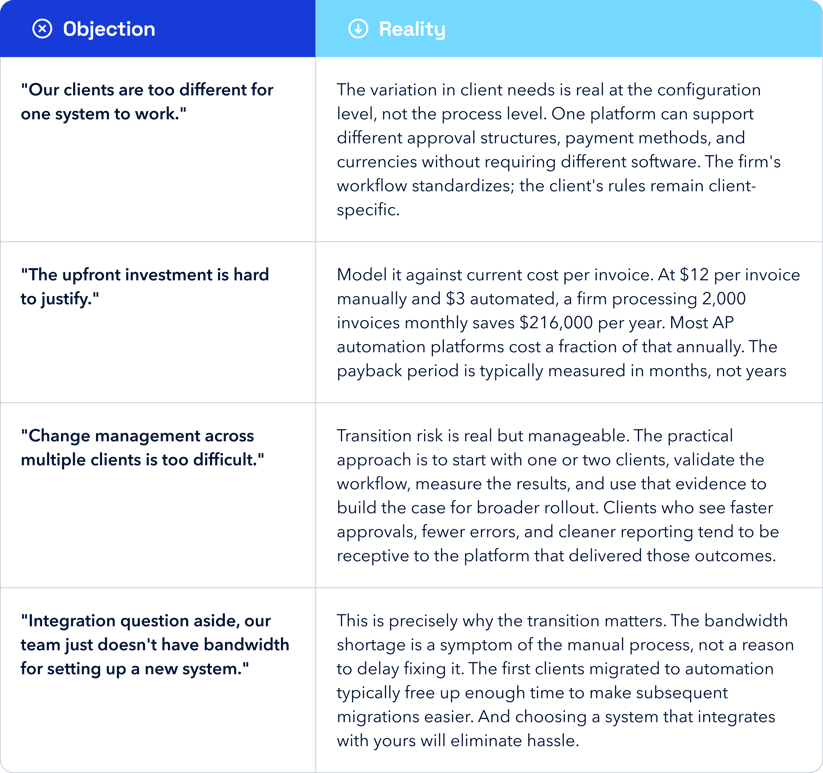
The objection firms most often raise to consolidation is that clients have different needs. Different payment terms, different approval structures, different vendor relationships, different jurisdictions. This is true. But standardization at the process level does not mean identical configuration at the client level.
A unified platform standardizes the workflow: invoices are captured, coded, matched, routed for approval, and executed for payment through the same sequence every time. What varies is the configuration within that sequence: who approves, at what threshold, in what currency, on what payment rails.
Another requirement for standardization is an AP tool that covers all your use-cases. Plooto supports payment by card through its pay by card feature, check payments online for vendors who still require it, CRA remittances for Canadian clients, and international business payments for clients operating across borders. Each payment type runs through the same approval and audit framework. The client experience varies; the firm's operational overhead does not.
Cross-client visibility and portfolio-level reporting
One of the underappreciated benefits of a unified system is the aggregate view it creates. When all client AP runs through the same platform, the firm can see patterns that are invisible when data is scattered across separate systems: which clients have the longest approval cycles, which vendor categories carry the highest error rates, which entities are missing early payment discount opportunities consistently.
That portfolio-level insight turns AP from a processing function into an advisory data source. Firms that use it proactively can bring specific, quantified recommendations to clients: not just "your AP process needs improvement" but "you are missing approximately $18,000 in annual early payment discounts because approvals are taking 14 days instead of 5."
Quantifying AP automation ROI: the metrics that matter
The ROI of AP automation is not difficult to calculate. It requires four inputs: current cost per invoice, target cost per invoice, total monthly invoice volume, and software investment. The gap between the first two, applied to the third and netted against the fourth, produces a payback period.
|
KPI |
Manual benchmark |
Automated benchmark |
Source |
|
Cost per invoice |
$10 to $15 |
$2.78 |
Ardent Partners / APQC |
|
Invoice cycle time |
17.4 days |
3.1 days |
Ardent Partners |
|
Early payment discount capture |
30 to 40% |
80 to 90% |
IOFM |
|
Invoice error rate |
2 to 10% |
Less than 1% |
IOFM / APQC |
|
AP automation payback period |
N/A |
6 to 12 months |
Industry consensus |
A firm processing 3,000 invoices per month across its client portfolio at $12 per invoice carries $36,000 in monthly processing costs. At $3 per invoice post-automation, that drops to $9,000. Before accounting for error reduction, fraud prevention, and discount capture, the labor savings alone exceed $300,000 annually , a return that justifies most AP automation software investments many times over within the first year.
For a more precise analysis, the Association for Financial Professionals (AFP) provides benchmarking frameworks that firms can use to model ROI against industry peers. The Hackett Group's finance benchmarking data provides additional context for what world-class AP performance looks like across specific industries and entity sizes.
Technology considerations for choosing a unified AP platform
Integration with accounting software is non-negotiable
A unified AP platform that does not sync directly with existing accounting software creates its own version of the fragmentation problem. Reconciliation that should happen automatically instead becomes a manual export-import cycle. Plooto's integrations ecosystem includes native two-way sync with QuickBooks and Xero, which means every payment executed in Plooto reconciles automatically in the client's accounting system. No re-entry, no batch imports, no end-of-month reconciliation scramble.
For firms managing clients in specialized industries, platform flexibility matters. Construction companies, for example, deal with project-based billing, retainage, and progress payments that require more nuanced approval workflows than standard invoice processing. A platform that can accommodate those structures without customization costs or workarounds serves the firm better at scale.
Approval workflows and controls that scale
The approval workflow is where most AP value is either captured or lost. Automated routing sends invoices to the right approver based on predefined rules: entity, dollar amount, vendor category, or cost center. Escalation rules prevent approvals from stalling. Threshold-based dual approval requirements enforce segregation of duties without requiring manual coordination.
For Canadian clients, maintaining compliant payment workflows extends to tax remittances. Plooto's online CRA payments feature handles federal and provincial tax remittances within the same platform, keeping all payment activity in one place rather than requiring a separate banking workflow for government payments.
Transparent pricing that works across a client portfolio
When evaluating AP automation platforms, firms should assess not just the base subscription but how pricing scales with invoice volume and client count. Plooto's pricing is designed for accounting firms and their clients, with a structure that does not penalize growth by imposing per-client fees that compound as the portfolio scales.
Addressing the most common objections to AP automation adoption
From cost center to competitive advantage
The firms winning on AP automation are not doing anything exotic. They picked a platform, standardized their workflow, applied it across their client portfolio, and measured the results. The cost savings showed up in the first year. The capacity freed up showed up in the ability to take on more clients without proportional hiring. The data insights showed up in more specific, more valuable advisory conversations with clients.
Accounts payable is not glamorous. But the gap between what manual AP costs and what automated AP costs is one of the clearest ROI calculations in finance operations. For firms that manage AP across multiple clients, consolidating under one unified platform is not a technology decision. It is a business model decision.
Plooto is built for exactly this: accounting firms and their clients, managing domestic and cross-border payments, with the controls and integrations that make a single-platform AP workflow practical rather than aspirational.
Ready to see the ROI for your firm? Start a free trial to see how Plooto unifies AP across your entire client portfolio.
Frequently asked questions
What is accounts payable automation?
Accounts payable automation is the use of software to handle invoice capture, matching, approval routing, payment execution, and reconciliation without manual data entry or human intervention at each step. It replaces paper-based or email-based AP workflows with a structured digital process that is faster, more accurate, and auditable.
What is end-to-end AP automation?
End-to-end AP automation covers the entire accounts payable lifecycle from the moment an invoice is received through coding, matching, approval, payment, and reconciliation. A platform with end-to-end automation eliminates the handoffs between manual steps that slow cycle times and introduce errors.
Is AP automation worth it?
Yes, for most firms and clients. APQC benchmarking shows that automated AP organizations process invoices at nearly four times lower cost per invoice than manual operations. The payback period for most implementations is 6 to 12 months. For accounting firms managing multiple clients, the ROI compounds because the efficiency gains apply across every client in the portfolio simultaneously.
How much does AP automation cost?
Cost varies by platform, invoice volume, and feature set. Cloud-based AP automation for SMBs typically runs from a few hundred to a few thousand dollars per month. The more relevant question for firms is cost relative to current manual processing expense. At industry benchmarks, automation pays for itself within the first year in most cases.
What is the difference between AP automation and ERP?
An ERP (enterprise resource planning) system manages broad business operations including inventory, HR, and financial reporting. AP automation focuses specifically on the invoice-to-payment workflow. Most AP automation platforms, including Plooto, integrate with accounting software and ERP systems rather than replacing them, sitting between the accounting system and the bank to handle payment execution, approvals, and reconciliation.
How does AP automation reduce fraud risk?
Automated AP enforces segregation of duties by routing invoices through defined approval chains rather than allowing any single individual to both approve and execute a payment. It also maintains a complete, time-stamped audit trail for every transaction, making unauthorized activity detectable and evidence-ready. Automated duplicate detection prevents the same invoice from being paid twice.