
Banks can be great for holding deposits, issuing loans, or sending a wire when you need to. But if you've ever tried to use your bank's business payment tools to manage your AP and AR, you’ve probably noticed the downsides: clunky interfaces, no automation, and a whole lot of manual work that falls back on your team.
Bank payment portals — including add-ons like RBC PayEdge — are exactly that: add-ons. They're bolted-on features built to extend an existing banking relationship, not purpose-built products designed around how finance teams actually work.
For banks, payment operations software are just an afterthought, with the investment to match. Compared to logging into your bank and initiating payments one at a time, they're an improvement. But a slightly better version of a broken process isn't the same as actually fixing it.
What bank solutions are (and aren't)
Let's be direct about what you're getting with a bank-based payment solution:
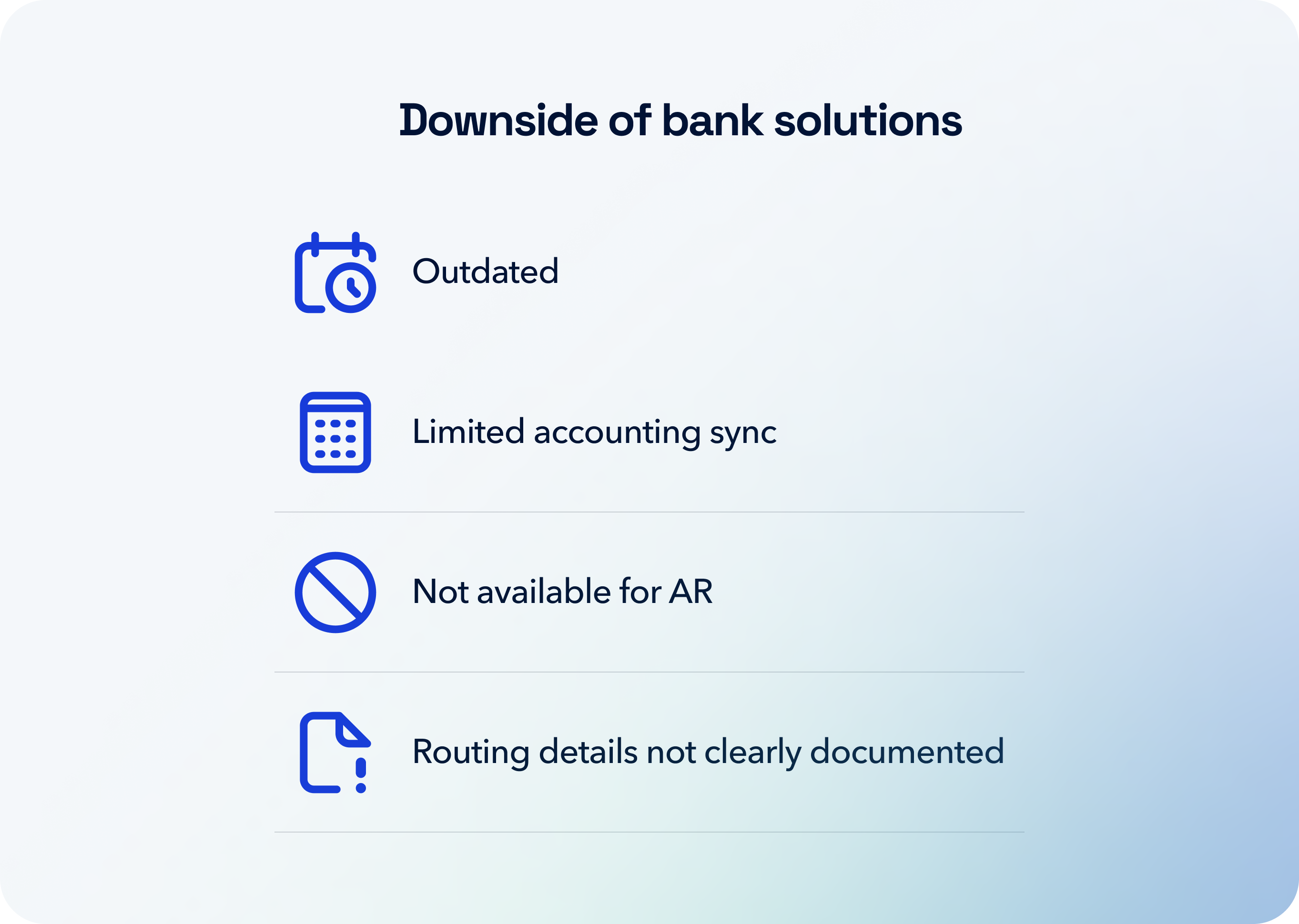
Standard bank portals give you a payment button. You can send money to one payee at a time. There are no approval workflows, no AR tools, no accounting sync, and no audit trail beyond a basic payment record.
RBC PayEdge is a step up from a standard banking portal — it has added some AP features over the years and offers more control than logging into your bank directly.
But the condition-based routing rules aren't detailed and don’t offer support for complex, real-life scenarios the accounting sync is lighter than purpose-built platforms, and it remains AP only, with no AR automation of any kind. Users have also widely criticized the interface as clunky, despite some recent feature additions.
Neither solution was built from the ground up to manage payment operations. They were built to extend what a bank already does.
What payment operations actually require
Running AP and AR for a Canadian SMB means handling a lot more than moving money from A to B:
- Getting invoices from your vendors, processing them, and routing them through the right approval chain before a dollar moves
- Collecting from your customers via PADs, credit card, or recurring billing — automatically
- Reconciling every transaction back to your accounting software without manual entry
- Staying audit-ready with a complete trail from request to approval to payment to reconciliation
- Managing CRA remittances alongside regular payables
- Handling international vendors at a reasonable cost (not $15–50+ wire fees)
While bank solutions may cover some of this, Plooto covers all of it and it connects directly to the accounting software you're already using.
The real cost of "good enough"
The hidden cost of using a bank portal or a lightweight AP tool isn't the subscription fee; it's the hours wasted. Every manually initiated payment, every reconciliation done by hand, every approval chased down over email represents real time from a real person on your team.
Plooto starts at $9/month. Greenhouse reported saving approximately 40 hours a month and $50,000 per year after switching to Plooto to manage their payments. The math is straightforward.

Unlike bank add-ons, Plooto gives you:
 Multi-level approval workflows with conditional routing on every plan
 Full AR automation — PADs, credit card acceptance, recurring billing, and automatic reconciliation.
 CRA payments built directly into your payables workflow
 International payments via global ACH to 40+ countries
 Faster payments through Plooto Instant and Plooto Express when timing matters
 Two-way sync with QBO and Xero
 A complete audit trail from request through reconciliation
 A modern platform that's built specifically for Canadian SMB payments
Your bank plays an important role — and so does Plooto. They just play very different roles.
Your bank holds your money. Plooto controls how it moves — automating the approvals, reconciliation, and collections workflows that your bank was never built to handle.
The result is less time spent on manual payment administration, real-time visibility into your cash flow, and meaningful savings that show up fast. The two work seamlessly together. But when it comes to actually running your AP and AR, there's no substitute for a platform built specifically for that job.